
Hawaiʻi County Release Date Types
Hawaiʻi state records separate several milestones. The judicial maximum is the sentence limit fixed under the court's judgment. The Hawaiʻi Paroling Authority sets a minimum term for an eligible state prisoner. A tentative parole date, often called a TPD, marks the expiration of the longest minimum and a point for parole consideration. The actual release date is the event recorded when the person leaves a specific custody site.
Those dates answer different questions. A favorable parole decision does not show that the person walked out that day. An approved plan, processing, another warrant, or a detainer may still affect departure. Maximum-term discharge follows a different authority. A transfer ends custody at HCCC or Kulani but continues custody in another place.
| Date | Meaning | Does it prove release? |
|---|---|---|
| Judicial maximum | Maximum sentence term based on the controlling court documents | No, it is a sentence milestone |
| HPA minimum | Minimum set for parole consideration | No |
| Tentative parole date | Expiration of the longest minimum and a consideration point | No |
| Actual release | Recorded departure or transfer event at a facility | Yes for that facility, subject to destination |
Lookup Hawaiʻi County Release Dates
No stable public DCR offender profile with a universal projected-release field was found. DCR directs public location questions to Hawaiʻi SAVIN/VINE. That service may show an estimate or event for a named person, but field availability can vary. Use the label exactly as displayed. Do not rename a minimum, tentative parole date, or estimated date as a guaranteed release date.
- Classify the custody. Decide whether the person is in an HPD cellblock, HCCC, Kulani or another DCR prison, federal custody, or immigration custody.
- Search the Hawaiʻi VINE person locator by exact name or offender ID. Note the status, location, event, and any date label.
- Search the eCourt Kōkua gateway for the judgment, sentence, bail action, resentencing, and later orders.
- For a state prison sentence, contact HPA for the minimum, tentative parole action, and individual order.
- Ask DCR for the current official time computation or release-status record when the public sources are unclear.
- After the date passes, confirm an affirmative release, discharge, or transfer event. The destination determines whether custody ended.
The DCR contact directory shown below helps identify the proper facility or office before requesting a computation.
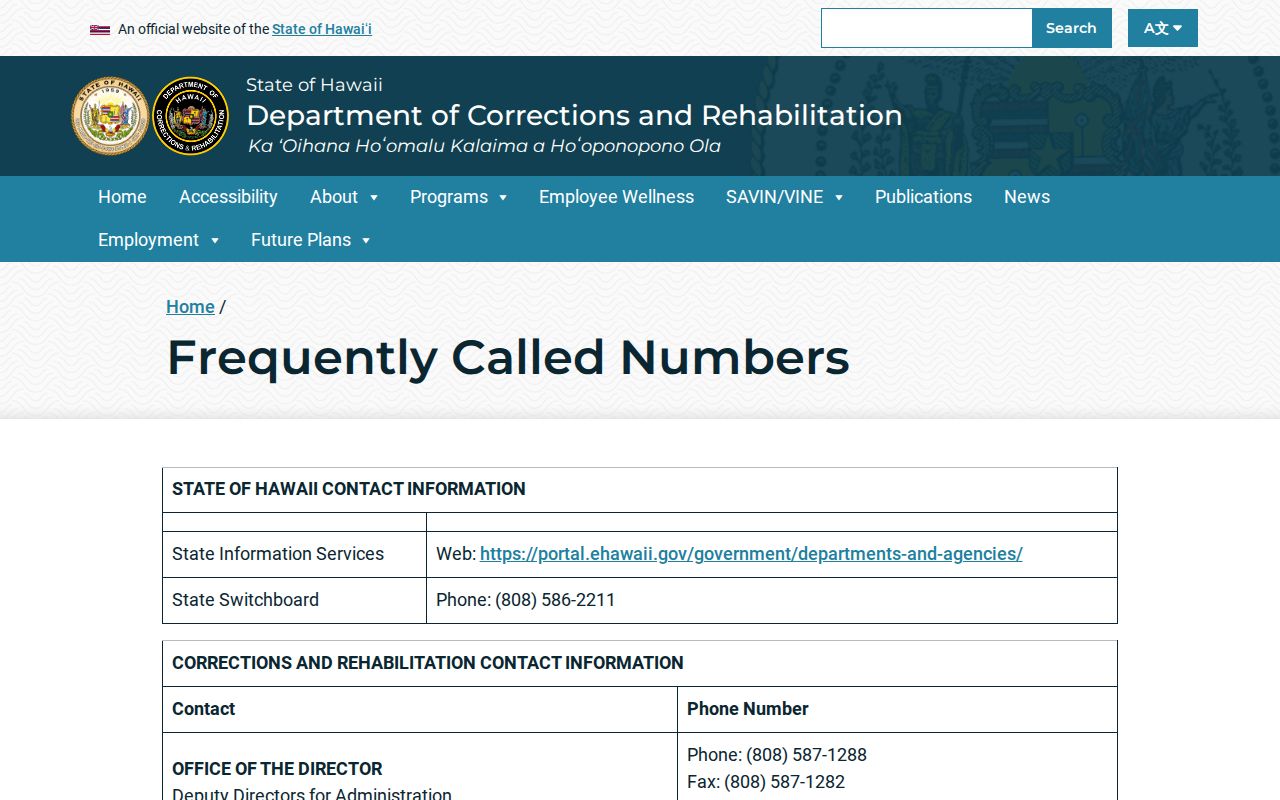
The directory routes the inquiry; it does not display or calculate a person's release date.
Hawaiʻi County Sentence Computation
DCR computes state sentences from authoritative court and agency documents under COR.05.05. The record can involve the judgment, mittimus, amended order, presentence credit, and other official material. A mittimus is the court document that commits a person to custody. If a controlling document changes, the computation can change as well.
The Hawaiʻi Penal Code in HRS Chapter 706 supplies the parole framework. HPA sets minimums under §§706-669 and 353-68. Section 706-670 addresses parole consideration, denial and review, and maximum-term release. HPA generally fixes the minimum within six months after commitment. An individual order controls the individual case.
No current blanket 85-percent rule was found. The old general good-time provisions in Chapter 353 are repealed, so it is inaccurate to subtract a stock percentage from the sentence. Credits, concurrent or consecutive terms, presentence detention, resentencing, warrants, revocation, and amended documents require an official computation. Concurrent terms run together to the extent ordered; consecutive terms run one after another.
- Presentence credit
- Credit the court or agency applies for qualifying custody before sentence.
- Concurrent terms
- Sentences served at the same time as ordered.
- Consecutive terms
- Sentences served one after another as ordered.
- Revocation
- Withdrawal of parole or probation after the required process.
- Detainer
- A request or hold from another authority that may affect transfer or release.
Why Hawaiʻi County Dates Change
A future date is a working record, not a fixed promise. DCR must apply the current controlling documents, and HPA must act within its authority. Another court or agency may add a hold. A later order may correct the sentence. VINE may also update after the underlying agency acts.
| Factor | Possible effect | Best source |
|---|---|---|
| Amended judgment or resentencing | Changes the term or credit inputs | Court order and DCR computation |
| Concurrent/consecutive terms | Changes how multiple sentences combine | Judgment and computation record |
| Presentence credit | Changes credited custody time | Court/DCR authoritative record |
| Parole grant or denial | Changes the parole path, not the judicial maximum | Individual HPA order |
| Warrant, detainer, or hold | May block community departure or cause transfer | Issuing agency and facility |
| Revocation | May return a supervised person to custody | HPA or court action |
| Administrative data lag | Public result may trail the official event | DCR and facility record |
First Step Act recalculation can also alter a future date for a federal inmate, but that is a BOP issue, not a Hawaiʻi DCR rule. Use the BOP Inmate Locator and repeat its recalculation caveat. Never apply federal rules to HCCC or Kulani.
Hawaiʻi County Pretrial Release
A person held before trial has no sentence-based projected release date. Release may depend on bail, recognizance, conditions, dismissal, acquittal, or another court order. HPD's Hilo and Kona cellblocks cover the initial arrest stage. HCCC then holds many pretrial detainees under DCR, even though people often call it the Hawaiʻi County jail.
Search the Third Circuit docket for the legal action and ask the current custodian whether processing occurred. “Case closed” does not itself establish release. A bail order does not state the exact moment a facility completed the release. If the person was cited and released from HPD without admission to HCCC, no DCR jail record may exist.
The HPD rolling 48-hour booking log carries Released On and Release Description fields for police processing. It is not a projected-date tool and does not cover every later HCCC event. For older or disputed entries, request the HPD cellblock record and the named court document.
Hawaiʻi County Parole Dates
HPA's minimum and tentative parole structure is central to a state-prison release-date lookup. Initial consideration occurs before the longest minimum expires under §706-670. A denial should carry written reasons and later review rules. A grant can still depend on a viable release plan and execution by DCR.
The reviewed HPA official page did not provide an individual public hearing calendar or decisions search. Contact HPA at 1177 Alakea Street, Ground Floor, Honolulu, HI 96813, (808) 587-1300. Have the full name, DCR number, case number, and sentencing court. Ask for the individual order and whether the date is a minimum, tentative parole date, scheduled event, or executed release.
A person released on parole remains supervised. Parole release is therefore not unconditional discharge. The Post-Release Supervision page explains HPA and Third Circuit verification paths.
Confirm Hawaiʻi County Release Dates
Register through the VINE Inmate Check for supported release, transfer, discharge, and parole notifications. Registration is useful, but the state warns against sole reliance. A recorded call may repeat until the four-digit PIN is entered. Text and email may arrive once. Contact the facility after the alert.
HCCC's public SAVIN listing is (808) 933-0428. Kulani is (808) 932-4430. Ask whether the person left that facility, the event date and time if public, and whether the result was community release or transfer. For a formal record, submit a narrow request under HRS Chapter 92F seeking the non-exempt actual release or transfer date, legal authority, and receiving category.
No result should be reported as “not confirmed through this channel.” It can reflect spelling, timing, system coverage, retention, or another sovereign. The correct next step is the official record, not an independent calendar calculation.
Hawaiʻi County Records Reconciliation
Three sources often answer three parts of one question. The court record shows the legal order and sentence. HPA shows parole authority and the individual decision. DCR shows time computation and actual facility processing. VINE supplies a timely public event. Keep each claim tied to its source.
If the dates conflict, ask DCR for the current computation and identify the court order that appears to control. Do not assume that the latest web timestamp is the latest legal document. An amended mittimus or resentencing order may take time to reach every interface. Likewise, an HPA hearing action can precede actual release.
A focused request is easier to process than a demand for every record. Provide the name, DCR ID, facility, case number, commitment date, and approximate date at issue. Request electronic segregable portions and a fee estimate. Do not ask DCR to calculate a new date for you; ask for the current official time-computation or release-status record.
Request Hawaiʻi County Date Records
eCourt Kōkua does not display every item from the official file. A missing document icon means the item is not online, not that the order does not exist. Sealed material will not appear, and older criminal information has system limits. Request the named judgment, amended judgment, mittimus, or release order from the Third Circuit clerk when the public docket is incomplete.
Hale Kaulike Legal Documents in Hilo is at 777 Kīlauea Avenue, (808) 961-7400. Keahuolū Courthouse Legal Documents in Kona is at 74-5451 Kamakaʻeha Avenue, (808) 322-8750. These court contacts provide documents. They do not set DCR or facility processing times, and their counter hours are not jail release hours.
Preserve the access date with any future estimate. Dynamic values can change after a new order, credit posting, parole action, or hold. Label a result with its source and exact field name. Later confirmation should state the actual event apart from the earlier estimate. That separation prevents a prior tentative date from being mistaken for proof of departure.
Federal Hawaiʻi County Release Dates
No BOP prison was identified in Hawaiʻi County. A federal defendant from the Big Island may be held at FDC Honolulu or another federal institution. BOP's nationwide locator covers federal inmates from 1982 forward and may display a release date with “Released” or “Not in BOP Custody.” That result ends only BOP custody.
A displayed federal future date can change after First Step Act recalculation or other official action. It should not be combined with Hawaiʻi's HPA minimum-term rules. Search by register number when possible, preserve BOP's exact label, and check the federal docket for the controlling sentence. A person may also remain under federal supervision after release.
ICE custody requires its own locator. A person who left HCCC under a detainer may have transferred rather than entered the community. A negative ICE result is not proof of release. Call the Detention Reporting and Information Line at 1-888-351-4024 for basic case information when the locator does not resolve the question.