
Federal Releases for Hawaiʻi County
The Federal Bureau of Prisons is a nationwide system. Its locator covers federal inmates from 1982 forward, including records for people no longer in BOP custody. A Hawaiʻi County connection does not imply confinement in the county. The relevant federal detention site in the state is Federal Detention Center Honolulu on Oʻahu, and a sentenced person may be designated to a mainland institution.
A BOP result may state “Released” or “Not in BOP Custody,” show a release date, and list no current federal facility. That establishes the end of BOP custody only. The person may be under federal supervised release, held by a state, transferred to immigration custody, or involved in another case. Keep the conclusion tied to the sovereign that issued it.
| BOP result | What it establishes | Next check |
|---|---|---|
| Current institution | Reported BOP confinement | Institution and federal docket |
| Released | BOP custody ended on the shown date | Court supervision and other holds |
| Not in BOP Custody | No current BOP confinement | Release date, docket, other sovereigns |
| No match | Not confirmed in the queried record | Search variants, USMS, court, ICE |
Search Federal Hawaiʻi County Records
The BOP Inmate Locator accepts a register number or name. A register number is the strongest key because names can repeat and spelling can vary. Search nationwide. Do not narrow the inquiry to FDC Honolulu merely because the case arose on the Big Island.
- Open the official BOP locator and choose number or name search.
- Use the register number when available. Otherwise enter the exact first, middle, and last name and try supported variants.
- Compare name, register number, age, race, and sex only as needed to reconcile identity.
- Read the location and release-date fields together. Preserve the exact status phrase.
- Check the federal court docket for sentence and supervision orders.
- If another custodian may be involved, search that system and request the transfer or release record.
The official BOP locator interface appears below. It shows the nationwide federal search route and is not a substitute for a live named result.
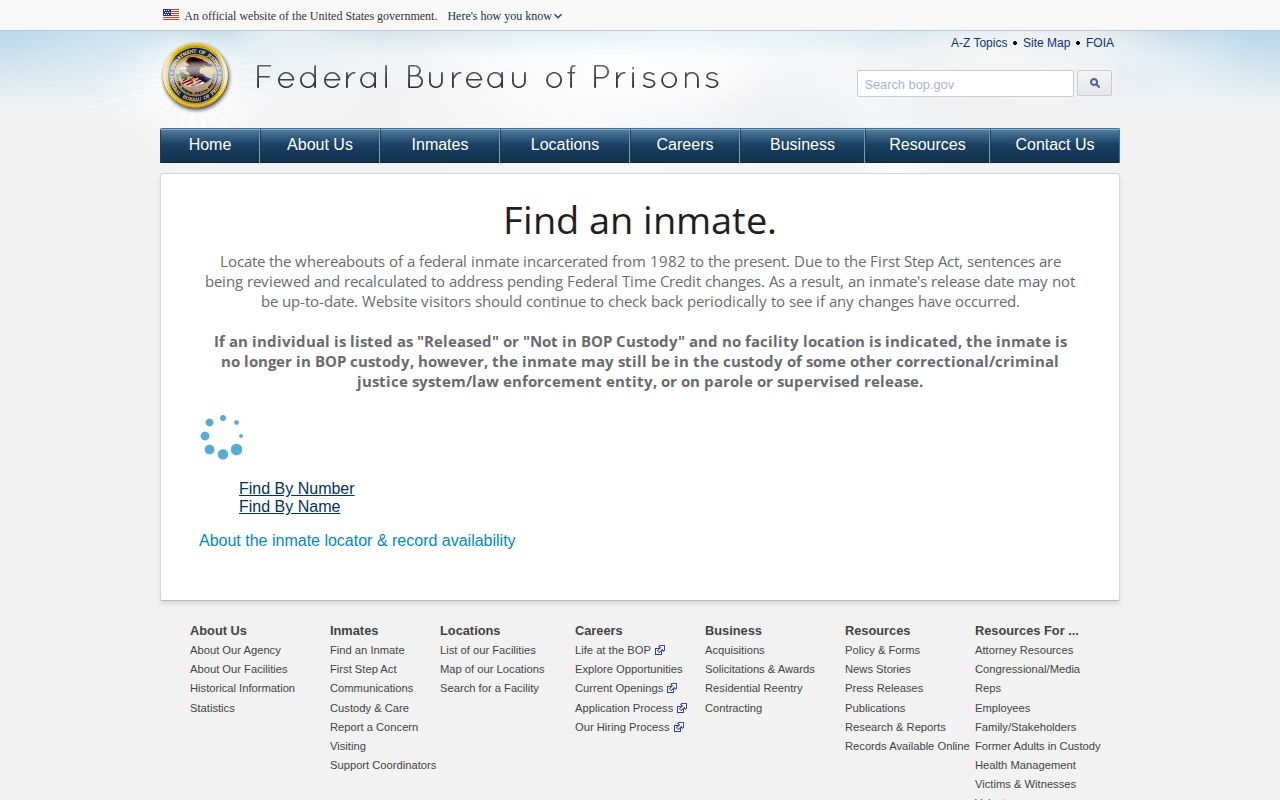
The live result should be saved with its access date because a future release field can change after official recalculation.
BOP Release Record Fields
BOP results can display the person's name, register number, age, race, sex, release date, and location. A past release date paired with a released or not-in-custody status is stronger than a blank name search. Still, it cannot identify every later form of custody or supervision.
A future date is not proof of release. BOP cautions that First Step Act calculations can affect displayed dates. Court amendments, sentence computation, designation changes, or other official actions can also affect the path. Do not create a countdown or independently subtract credits. Use the date and caveat exactly as BOP displays them.
- Register number
- The federal identifier used to distinguish an inmate in BOP records.
- Release date
- The date displayed by BOP, past or future, subject to the record's context.
- Not in BOP Custody
- A status ending only the BOP confinement question.
- Supervised release
- Federal court supervision after prison, distinct from Hawaiʻi parole or probation.
The Release Date Lookup explains why federal calculations must remain separate from Hawaiʻi DCR and HPA rules.
FDC Honolulu Release Context
FDC Honolulu is the relevant federal detention facility in Hawaiʻi, but it is on Oʻahu and is not a Hawaiʻi County facility. It can hold federal pretrial detainees and other people within its federal mission. A Big Island arrest may therefore move off island even before a federal case reaches sentence.
The official FDC Honolulu facility page is shown below to establish the off-island federal custody context.
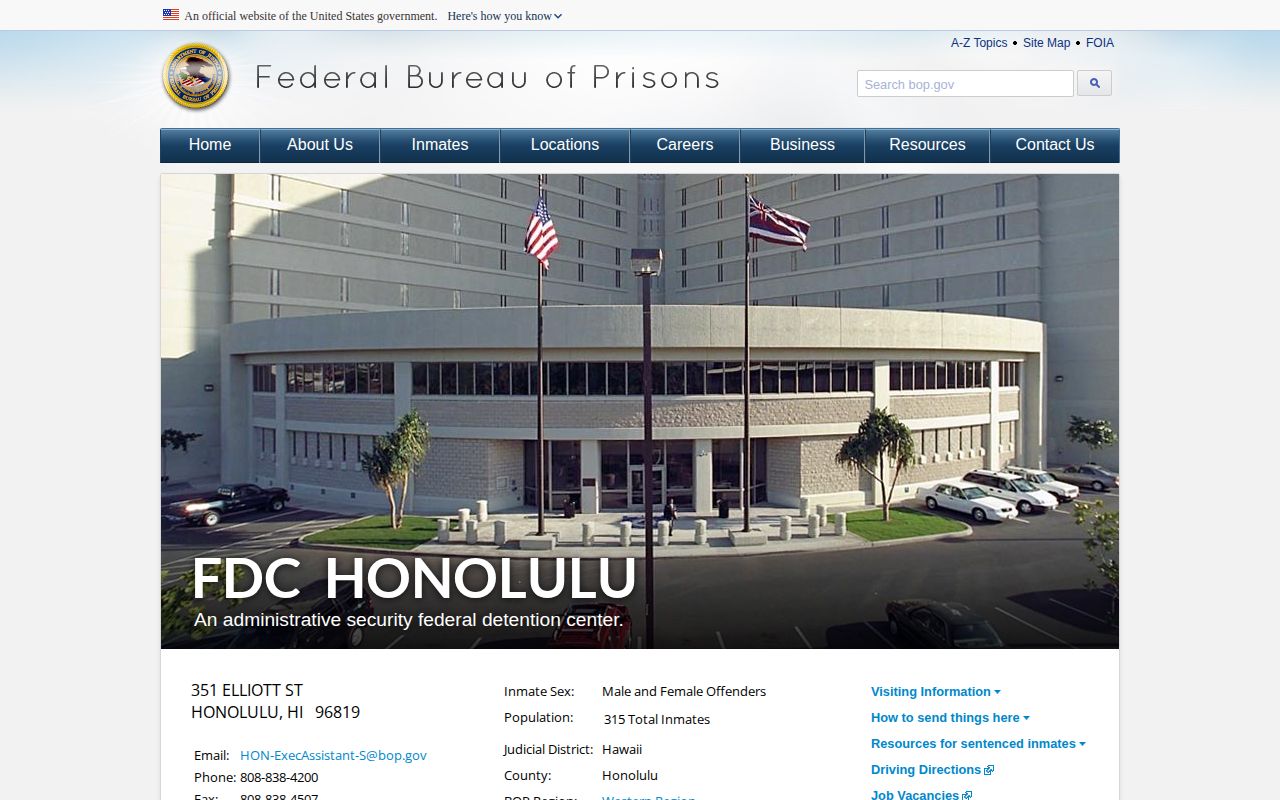
The facility page supports location and contact routing. The BOP locator and the individual federal docket establish the person's record.
A departure from FDC Honolulu can mean release, transfer to another BOP institution, court movement, USMS custody, or immigration action. Ask for the receiving agency when the event is a transfer. The absence of a local BOP institution is not evidence that no federal custody exists.
Confirm a Federal Release
Confirmation requires more than one screen when the outcome matters. The locator supplies BOP status. The federal docket supplies the judgment, sentence, detention or release order, and supervised-release terms. The institution or BOP record supplies actual processing. USMS may handle pretrial transport, though no public Hawaiʻi County USMS release roster was found.
- Save the live BOP status, date, register number, and access time.
- Locate the federal criminal case and read the judgment and later release-related orders.
- Distinguish release from transfer. Follow the receiving agency named in the record.
- For an older or disputed event, request the specific BOP or court document rather than relying on a saved search result.
- Check ICE only when immigration custody is a plausible next route.
Do not import the Hawaiʻi SAVIN route into a federal inquiry. SAVIN covers DCR jail, prison, and supported parole events, not BOP custody. The Hawaiʻi County released-inmate workflow separates state, local, federal, and immigration paths.
Federal Court and Supervision
Federal release from prison may begin supervised release. That is a federal court term and is not Hawaiʻi state parole or Third Circuit probation. A released BOP status does not show every supervision condition. Read the federal judgment and contact the federal supervision office through the court system for a current case-specific question.
A pretrial defendant may be released under a court order without ever serving a BOP prison sentence. The docket is then the stronger legal trail, while the custodian's processing record shows when physical custody changed. Likewise, a sentence of time served can end confinement but still include a term of supervision.
When reporting the result, state: BOP released status and date, the court's supervision order, and any separate receiving custody. Do not collapse these into the vague phrase “is free.” Each source has a narrower and more accurate meaning.
ICE Holds After Federal Custody
ICE identifies FDC Honolulu as a detention site, which makes federal and immigration pathways overlap in Hawaiʻi. A person can leave BOP criminal custody and enter ICE civil custody. In that case, the BOP released status remains accurate for BOP, but it does not mean return to the community.
Search the ICE Online Detainee Locator with a nine-digit A-number and country of birth, or exact name and country of birth. The locator covers current ICE detention and qualifying CBP custody over 48 hours. It excludes minors. A negative result is not an immigration release certificate.
For basic case information after a failed search, call the ICE Detention Reporting and Information Line at 1-888-351-4024. Keep the BOP and ICE events separate. The transfer record should identify which agency received the person.
Federal Release Records Requests
A focused records request should identify the name, register number, institution, case number, and approximate date. Ask for the particular release, transfer, or sentence-computation record needed to verify the event. Avoid a broad request for an entire institutional file. The federal agency will apply its own disclosure laws and exemptions.
For a court record, request the named judgment, detention order, release order, or docket entry through the federal court's process. A case number and document title reduce search burden. Certified copies, ordinary copies, and online docket access can have different fees.
Preserve the source hierarchy. The individual court order or custody record controls the individual event. Current law and policy follow. A live official result is useful but may update. News reports and private databases should not override the official custody trail.
No Hawaiʻi County BOP Prison
The absence of a BOP prison inside Hawaiʻi County is a routing fact, not a gap to fill with a local jail search. HCCC is a state DCR jail. Kulani is a state prison. HPD's Hilo and Kona cellblocks are county police lockups. None is a federal BOP institution.
A federal defendant may pass through local arrest or court channels before federal transfer, but the federal record belongs in the BOP locator and federal docket. Conversely, a person in HCCC does not become a federal inmate merely because a federal detainer may exist.
Start with the authority that actually held the person. Move to the next system only when a transfer, court record, or reliable agency statement points there. This custody-first method prevents a missing local result from being mistaken for release.