
Releases From Kulani Correctional Facility
Kulani holds sentenced state prisoners, so its release path differs from the pretrial and short-term work of HCCC. A person leaving Kulani may be paroled, furloughed, moved to another community placement, discharged at the sentence maximum, or transferred within DCR. “Not at Kulani” is only a location finding until an official event identifies the next status.
Parole is community release under HPA supervision. Furlough or another community placement has its own legal and correctional terms. Maximum-term discharge ends the stated prison term, subject to any other lawful custody. A DCR transfer ends custody at Kulani but not state custody. State each outcome as recorded instead of using the broad phrase “released” for all departures.
The actual DCR event when custody changes. A hearing, tentative date, or favorable parole decision can precede that event.
How to Confirm a Kulani Release
DCR does not maintain a conventional public, permanent offender-profile search with a stable discharge page. Its “Locate an Offender” route is Hawaii SAVIN/VINE. That system supplies current custody and parole events, but it is not a permanent archive. The correct check adds HPA and DCR records when the event concerns parole or an older discharge.
- Search Hawaii SAVIN/VINELink under Hawaii using the exact name and offender ID when known.
- Compare the identity, open the matching record, and read the current custody, release, discharge, parole, or transfer label.
- If parole applies, obtain the individual HPA order and distinguish a tentative parole date or decision from actual release.
- Review the sentencing docket for judgment, sentence, maximum term, and later court orders, while recognizing that it may not record DCR's processing time.
- Request the DCR release or transfer record for the actual date, authority, and receiving category.
A no-match result can reflect spelling, coverage, timing, or retention. It cannot be restated as discharge. For a named person whose custody history may include HPD, HCCC, federal, or immigration systems, use the Hawaii County released-inmate lookup to classify the source first.
Kulani Records and Contact
The facility can provide current operational routing, but a written DCR request is the stronger route for a historic release or transfer record. Use enough identifiers to isolate one custody episode and avoid asking for unrelated private information.
Kulani Correctional Facility
Mailing address: PO Box 4459, Hilo, HI 96720
Telephone: (808) 932-4430
Operator: Hawaiʻi Department of Corrections and Rehabilitation
Facility type: Minimum-security state prison
Ask DCR for the non-exempt release or transfer record for the named person and include the DCR ID, sentencing case, and custody date when known. Request the actual event date and time, legal release type or authority, and receiving facility or agency category if public. Ask for electronic segregable portions, exclude medical, victim, residence, security, and supervision-condition details, and request a fee estimate before a chosen cap.
Note: DCR's central contact is (808) 587-1288, and the Hawaii SAVIN information line is 1-877-846-3444.
About Kulani Correctional Facility
Kulani is a 200-bed minimum-security prison on Mauna Loa, about twenty miles southeast of Hilo. It is the only state prison on Hawaii Island. DCR describes programs and educational and cultural offerings that prepare sentenced prisoners for furlough and reentry.
Those facts describe the facility and its correctional mission. They do not establish a personal outcome, a release date, or eligibility for a given program. A prisoner may still transfer elsewhere in DCR, and people sentenced in Hawaii County can be held at Oʻahu or mainland contract facilities. A statewide search and records inquiry should not be restricted to the island.
The official Kulani facility page provides the location and program context shown below.
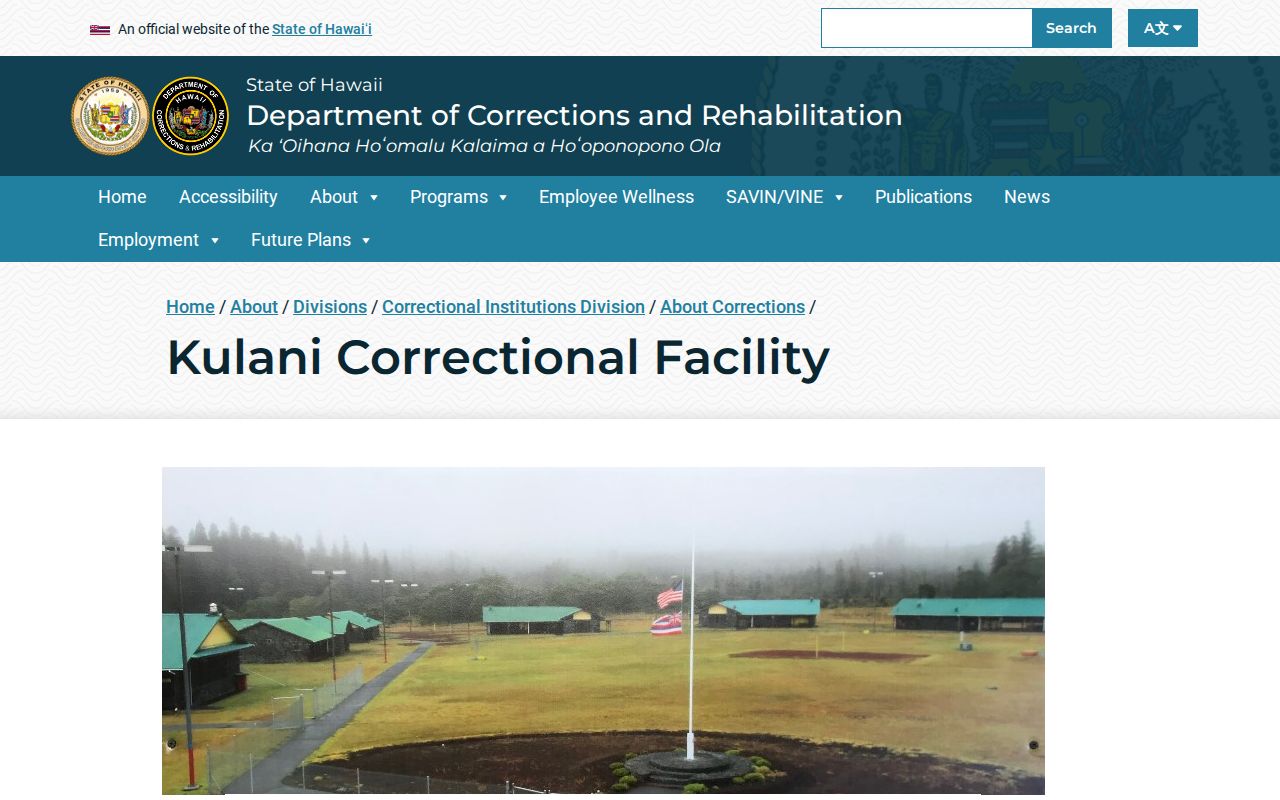
The official source identifies Kulani as a DCR prison, which is why a state parole and discharge trail replaces the local police booking-log path.
Kulani Tentative Parole Dates
Hawaii's parole-planning term is tentative parole date, often shortened to TPD. HPA's handbook explains that expiration of the longest minimum term makes the prisoner eligible for parole consideration. It is not an appointment to leave Kulani. A hearing is normally held near that point, and release can still depend on the decision, an approved plan, and DCR processing.
HPA's minimum-term system uses the judicial maximum, its guidelines, and an individual order rather than a universal percentage. The research found no current codified blanket “serve 85 percent” rule. Former good-time provisions were repealed, and an old legislative proposal must not be treated as governing law. DCR's sentence-computation record and HPA's individual order are the proper sources.
A result such as granted, denied, Chair to Set, suspended or revoked, reparole, or discharge should retain its official meaning. “Chair to Set” is conditional and does not supply an actual release date. Confirm the executed event through SAVIN, HPA, and DCR.
Kulani Parole, Furlough, and Reentry
Kulani's minimum-security role and required programming support preparation for furlough and reentry. That makes the facility a transition point for some sentenced prisoners, but not every departure is community release. Individual classification, program status, HPA action, and the approved plan determine the path.
For parole, HPA is the authoritative agency for the order and public supervision verification. Its main number is (808) 587-1300, and its listed office hours are weekdays from 7:45 a.m. to 4:30 p.m., except holidays. SAVIN can report parole-status events. Neither a public program description nor a hearing date proves that a person has left Kulani.
Probation is different. It belongs to the Judiciary and may follow a jail term or be imposed without a prison term. Do not route a Kulani parole question to Adult Probation merely because both involve post-release supervision. Use the sentencing docket to identify the legal status and the correct agency.
Kulani Discharge and Island Return
At the maximum term, DCR policy generally returns a person to the island of conviction or sentence. Parole destinations follow separate rules and can have exceptions. Eligible in-state air travel may be paid under the return policy. These are planning rules, not proof of one person's destination.
No official source established a Kulani gate-release hour, family waiting area, weekend schedule, fixed transit stop, or guaranteed travel route. Contact the facility for current logistics. Report the destination or receiving category only when the individual release record makes it public.
A maximum-term date is not always the same as the moment a person reaches the community. Another jurisdiction, federal authority, or ICE can accept custody. A DCR record stating transfer should not be shortened to “discharged” unless that is the actual recorded event.
Kulani Transfers Beyond Hawaii County
No BOP prison or dedicated ICE detention center was found within Hawaii County. The relevant federal detention facility in the state is FDC Honolulu on Oʻahu. A person with a Hawaii County connection can also be held in another DCR institution or a mainland contract facility. Location disappearance is therefore a starting point, not a conclusion.
For a federal handoff, use the BOP locator and federal docket. “Released” or “Not in BOP Custody” ends only the BOP part of custody. For immigration detention, use the ICE locator or call the Detention Reporting and Information Line at 1-888-351-4024. A negative result is not proof of community release.
The DCR transfer record supplies the bridge between systems. Ask for the receiving agency or facility category if public, then continue in that agency's official source. This preserves the distinction between leaving Kulani and leaving all custody.
Kulani in Hawaii's State Corrections System
Hawaii County's custody records are divided by agency. HPD runs short-term cellblocks and the 48-hour arrest-and-charge log. HCCC is DCR's state jail for pretrial and short-term custody. Kulani is DCR's sentenced-prison facility. HPA handles parole, and the Third Circuit preserves the judgment and sentence.
An HPD booking PDF is generally an old arrest lead for a Kulani prisoner, not a prison-discharge record. The Third Circuit can establish the judicial maximum but not necessarily the executed release. SAVIN, HPA, and DCR are the primary release sources. Following that division prevents a county-jail process from being wrongly applied to a state-prison departure.
Note: The best evidence order starts with the individual court or facility record, then current law, policy, and official status results.
Public Record Search
Sponsored Results