
Hawaiʻi County ICE Transfers
ICE custody is a federal civil immigration path, not a Hawaiʻi County jail sentence. No dedicated ICE detention center was identified on Hawaiʻi Island. Hawaiʻi Police Department cellblocks handle short-term police custody, and the Hawaiʻi Department of Corrections and Rehabilitation operates HCCC. If either agency records a handoff to ICE or another federal authority, the person has left that local or state facility. That fact does not prove community release.
The receiving federal facility may be off-island. The relevant detention site identified by official sources is Federal Detention Center Honolulu on Oʻahu. A transfer can also involve other federal routing, so an old Hawaiʻi County address should not narrow the search to the Big Island. Describe the event precisely: the person was released from HPD processing to a receiving agency, transferred from HCCC, or located in current ICE custody. Each statement answers a different question.
A transfer ends one agency's custody episode but does not establish release from all government custody.
Search Hawaiʻi County ICE Custody
The ICE Online Detainee Locator System searches current ICE detention and certain U.S. Customs and Border Protection custody lasting more than 48 hours. It does not include minors. The search supports two identity paths. An A-number search needs the nine-digit immigration identification number and country of birth. A biographical search needs the exact first and last name, country of birth, and an optional birth date.
- Choose the A-number route when the nine-digit number is known. Add a leading zero if the known number contains only eight digits.
- Otherwise enter the exact first and last name. Try accurate spelling variants only when punctuation, spaces, or multiple surnames may differ.
- Select the correct country of birth. Add the birth date when available to narrow common-name results.
- Read the returned custody and facility information as current locator data. Save the date and time checked because placements can change.
- If no person appears, call the official information line and continue through the transferring agency record. Do not label a no-match as release.
The locator is strongest for the question it was built to answer: whether an adult is currently shown in covered ICE or qualifying CBP custody. It is not a permanent release archive, a state jail roster, or a certificate that an immigration matter has ended. A spelling mismatch, data lag, transfer, short CBP episode, or system coverage limit can affect the result.
Hawaiʻi County ICE Custody Contacts
When the online search does not resolve the question, ICE directs callers to the Detention Reporting and Information Line for basic case information. This is the main public escalation route documented for a person who may no longer appear in the locator. Have the full name, A-number if known, country of birth, birth date, and details about the last confirmed custody event ready before calling.
ICE Information
Online Detainee Locator
locator.ice.gov
Detention Reporting and Information Line
1-888-351-4024
Scope
Current ICE detention and qualifying CBP custody
ICE is the proper source for current immigration custody. HPD can document whether a person left a Hilo or Kona cellblock and identify the released-to or receiving field in its record. DCR can document an HCCC release or transfer. Neither local source should be asked to certify what happened after another sovereign accepted custody.
Note: A negative locator result means ICE custody was not confirmed through that search, not that the person returned to the community.
No Hawaiʻi County ICE Facility
The absence of an ICE detention building in Hawaiʻi County is a key search fact. It prevents a false assumption that every federal detainee with a Big Island case remains on the island. FDC Honolulu is on Oʻahu and appears in both BOP and ICE official facility material. The location can serve federal criminal detention and an immigration detention role, but the agency and legal basis must still be identified for the individual person.
The official ICE page for FDC Honolulu shows the federal detention context that may follow a Hawaiʻi County transfer.
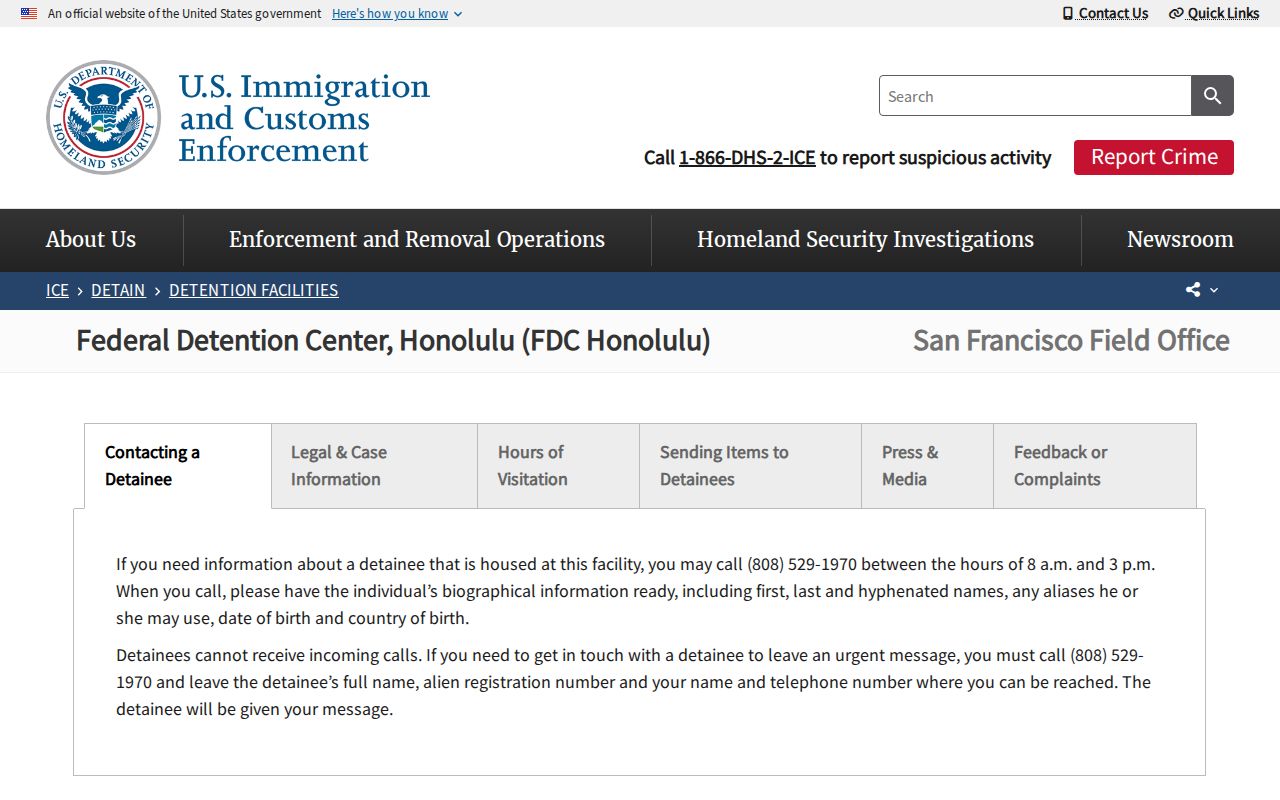
This source helps establish the off-island detention route. It does not prove that a named person is there, so use the locator or official phone line for person-specific confirmation.
Federal criminal custody is a separate path. When a federal criminal case or U.S. Marshals transfer is possible, search the BOP locator and the federal court docket as well. A BOP result that says “Released” or “Not in BOP Custody” ends only the BOP part of the trail. It does not rule out ICE, state custody, another jurisdiction, or post-custody supervision.
Hawaiʻi County ICE Agency Trail
Hawaiʻi County's unified state corrections structure makes this distinction vital. DCR, not a county sheriff, runs HCCC. HPD separately operates the Hilo and Kona police cellblocks and publishes a rolling 48-hour booking report. A person can therefore move from HPD to court, from court to HCCC, from HCCC to a federal receiving agency, and then off-island. A gap in any one roster captures only part of that chain.
| Record wording | What it establishes | Next check |
|---|---|---|
| Released from HPD cellblock | The police booking episode ended | Read the receiving field, court docket, and SAVIN if HCCC was involved |
| Transferred from HCCC | DCR custody at that facility changed | Identify the receiving agency and search its locator |
| ICE locator match | Current covered federal immigration custody | Use the listed facility and ICE contact path |
| No ICE match | Custody was not confirmed in that query | Call DRIL and request the transfer record |
| Not in BOP custody | No current BOP custody | Check ICE and any other possible sovereign |
A court dismissal also needs careful reading. It may resolve one criminal charge while an immigration hold or another warrant remains. The court order shows the legal action in that case. The facility record shows physical processing, and the ICE result addresses the later federal immigration stage.
Hawaiʻi County Transfer Records
When the destination is unclear, request the record from the agency that made the handoff. For an HPD cellblock episode, ask the Records and Identification Section for the non-exempt adult booking or cellblock record, including the Released On date and time, Release Description, and released-by or receiving agency. Include the person's name, arrest date, report number, OTN, and case number when known.
For HCCC, direct a focused request to DCR. Ask for the non-exempt release or transfer record showing the actual event date and time, legal authority or type, and receiving agency or facility category. A request should exclude medical, victim, residential, security, and unrelated private information and ask DCR to provide segregable public portions. Hawaiʻi's UIPA process under HRS Chapter 92F applies to state and county agency records, but it does not turn ICE's federal files into state records.
Federal immigration records use federal processes and can involve privacy limits. The practical first step for basic current information remains the ICE locator and DRIL. If a local agency's record says only “federal” or “other agency,” pair that record with ICE, BOP, and the relevant court docket rather than guessing which federal branch received the person.
The broader Hawaiʻi County released-person search explains how to reconcile HPD, DCR, court, BOP, and ICE records when the initial custody type is uncertain.
Reconcile Hawaiʻi County ICE Records
Start with the last affirmative record, then move forward one agency at a time. If HPD says “Released to District Court,” inspect the court docket because the judge may release, set bail, remand the person to HCCC, or address another warrant. If SAVIN shows a transfer, identify whether the new location remains within DCR or points to another jurisdiction. Only then use the matching federal locator.
Names can be hard to reconcile across systems. Compare the A-number, offender number, court case number, arrest date, and lawful identity details instead of relying on a name alone. Hawaiʻi names may contain an ʻokina, hyphen, space, or more than one surname. ICE exact matching makes careful variants useful, but unnecessary personal identifiers should not be published.
- Detainer
- A request or legal mechanism that can lead one agency to hold or transfer a person for another authority.
- Transfer
- A movement from one facility or agency to another without ending all custody.
- Community release
- An affirmative departure from physical custody, which may still include supervision or an active case.
- A-number
- The immigration identification number used for the ICE locator's number-based search.
Use narrow language when proof remains incomplete. “Not confirmed through the ICE locator” is accurate. “Released” is not. That wording preserves the difference between a failed search and an official custody event.