
Hawaii County 72-Hour Release List Availability
The official sweep found neither a rolling three-day released-person view nor a county sheriff roster. HPD's 48-Hour Media Booking Log is the useful local source. It contains Released On and Release Description fields, but its main subject is adults arrested and charged during each printed report period. Building a 72-hour picture may require reviewing more than one PDF and reconciling repeated or updated entries.
The visible archive had a limited set of reports when researched, but HPD states no retention term. Save the relevant official PDF when the matter is current. For older events, request the record from HPD, DCR, or the Third Circuit based on which agency created it.
How to Build a Hawaii County Three-Day View
The goal is to cover the chosen period without counting one person twice or confusing a transfer with community release. Set the start and end time first. Then use the dates printed inside the reports, not just the archive link labels.
- Open the HPD booking-log archive and identify every PDF whose printed range overlaps the chosen three days.
- Search each file for the name or review each Released On value that falls within the exact window.
- Match repeat entries through report number, OTN, arrest time, charges, and court data before counting an episode once.
- Read the Release Description and released-by fields. Keep labels such as court or Intake Service Center intact.
- Verify current status with the Hilo or Kona cellblock, Hawaii SAVIN/VINE after DCR intake, and the Third Circuit docket when court action matters.
The Hawaii County 24-Hour Releases page is the better route for a same-day check based on the newest report. A wider window is useful only when its sources and overlaps remain visible.
What Hawaii County 72-Hour Records Show
The report fields make a cautious multi-day review possible. They do not all answer the same question. Arrest and charge columns identify the episode; release columns describe the end of police processing; court and agency fields point to the next stage.
| Field | Use in a three-day review |
|---|---|
| Arrested On | Places the arrest event within a report and helps distinguish a later repeat line. |
| Released On | Supplies the recorded date and time of departure from the HPD processing episode. |
| Name, age, sex, race, city/address | Helps reconcile identity while avoiding publication of details not needed for the check. |
| Officer, report number, OTN | Connects repeated lines and gives useful identifiers for an official inquiry. |
| Statute and charge | Shows the allegation and whether a line is marked as arrest or charge activity. |
| Bail set and posted | Records bail information in the HPD report, subject to the controlling court order. |
| Release Description | May state bail, bond, supervised release, court, or Intake Service Center. |
| Released by, court code/date | Helps route verification to the correct agency or Third Circuit case. |
A blank Released On field does not prove current custody. A release to court proves departure from the cellblock to that destination, not what happened after court. The reports contain no mugshot and are not a DCR offender-photo archive.
Note: Keep the original PDF and printed time range so a later reader can see exactly what the source covered.
Why Hawaii County 48-Hour Logs Can Repeat
HPD warns that the 48-hour reports can change and can repeat entries based on arrest and charge timing. A person may therefore appear in overlapping reports or on more than one line. That feature is useful for following changes, but it makes simple name counts unreliable. Compare identifiers and facts before treating two lines as two releases.
The archive screenshot source shows the official report context used for this wider review.
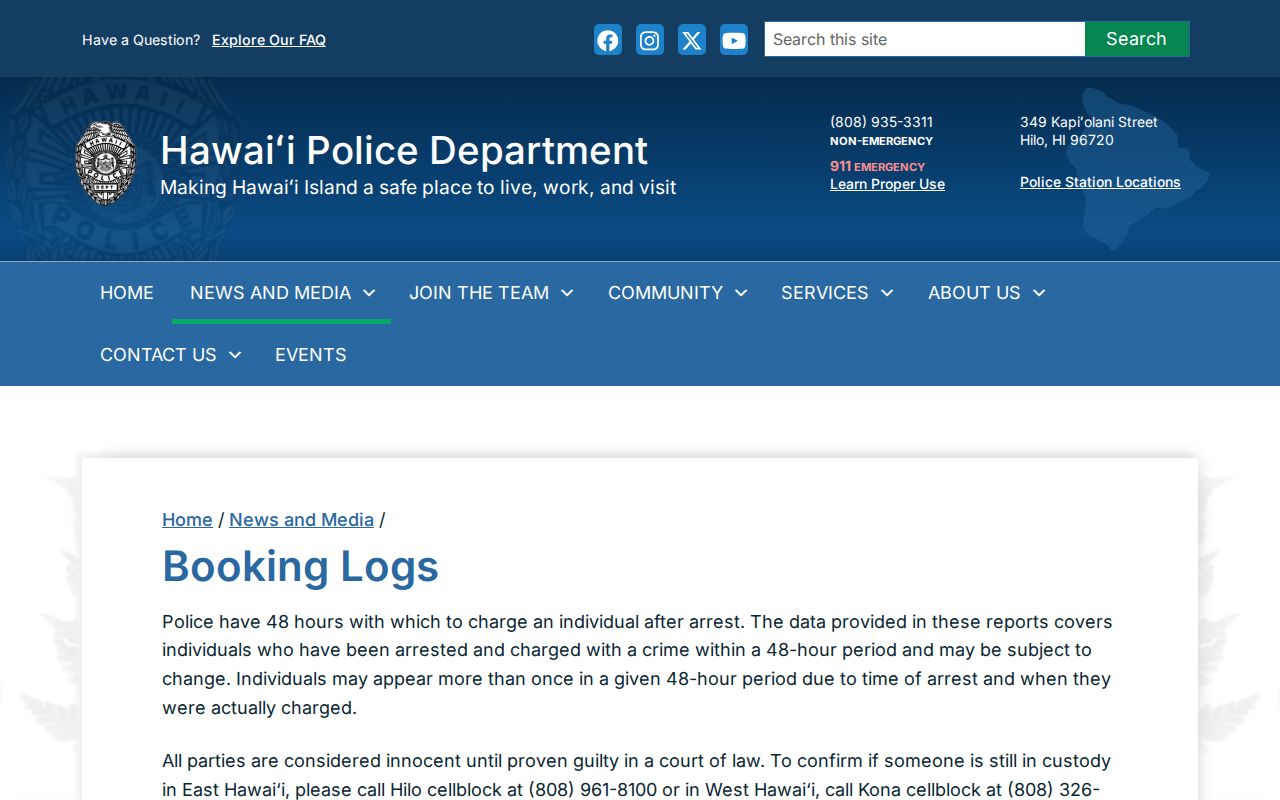
The page supplies dated files rather than an interactive release filter. Its format explains why three-day research needs source-by-source reconciliation instead of a scraped combined list.
Weekend Timing in Hawaii County Release Records
A three-day window can span a weekend, but the research found no official HCCC weekend or holiday release schedule. It also found no confirmed gate hours, family waiting area, or direct jail bus stop. Do not infer those details from a PDF timestamp or from court hours.
The Third Circuit says its court channel accepts and processes bail on weekdays from 7:45 a.m. to 4 p.m. That fact describes the court counter only. HPD and DCR have separate processing duties, and the listed hours do not mean every other release step stops outside them. A court order can precede the facility's recorded event, and another hold can change the outcome.
A court order supplies legal authority. An HPD or DCR entry records operational release or transfer. A current-status system describes what it reports at the time checked.
Confirming Hawaii County Release or Transfer
Match the check to the custody system. For immediate HPD cellblock status, call Hilo at (808) 961-8100 or Kona at (808) 326-4646, extension 293. If the person went to HCCC, use Hawaii SAVIN/VINELink and DCR. HCCC is a state jail for pretrial and very short-term sentenced custody; it is not operated by a Hawaii County sheriff.
Search the Third Circuit docket for bail changes, dismissal, release orders, judgment, sentence, or time served. The docket can explain the authority, while the custody record supplies actual processing. If a person entered a state-prison term, add HPA and DCR records. A parole grant or tentative parole date is not proof that release occurred.
Federal and immigration paths stay separate. The BOP locator can show release from federal custody, and ICE's locator or information line addresses current immigration detention. A departure from HCCC followed by a federal or ICE handoff is a transfer between systems, not confirmed return to the community.
Older Hawaii County Release Record Requests
For an older cellblock episode, send HPD a narrow UIPA request that identifies the person, arrest date, report number, and OTN when known. Ask for non-exempt booking or cellblock fields showing Released On, Release Description, bail, and the released-by or receiving agency. Request electronic segregable portions and a fee estimate before a stated cap.
For an HCCC episode, ask DCR for the non-exempt release or transfer record, including the actual date and time, legal authority, and receiving agency or facility category. For the legal basis, request a public release order, dismissal, judgment, sentence, or minutes from the Third Circuit using the case number and approximate date.
A no-match result can stem from spelling, timing, limited retention, the wrong sovereign, or transfer. The careful conclusion is that release was not confirmed through that channel. For one person's complete path, use the Hawaii County released-inmate lookup and work from the known arrest or facility outward.
Note: VINELink is designed for timely status and alerts, not permanent archival proof of every past Hawaii County release.
Separating Hawaii County Custody Systems
A three-day review becomes more reliable when each source is assigned one job. HPD handles the short-term Hilo and Kona arrest path and publishes the booking PDF. HCCC is a DCR jail. Kulani is a DCR state prison. The Third Circuit supplies the legal case history, while HPA addresses parole decisions and supervision. BOP and ICE each answer a separate federal question.
Do not carry an HPD release description forward as a claim about HCCC or prison discharge. If the entry says the person went to the Intake Service Center, court, or another receiving entity, follow that route. Likewise, a SAVIN transfer event shows a custody change, not unconditional discharge. An affirmative release event still needs the right identity and agency scope.
For older matters, eCourt can outlast a transient custody screen. Search by case number when possible and review dismissal, bail, judgment, sentence, probation, revocation, and satisfaction events. A closed case is not itself a custody status, and an open filing does not prove confinement. Use the docket to explain legal authority, then obtain the facility record for the operational time.
Public Record Search
Sponsored Results