
Releases From Hawaiʻi Community Correctional Center
HCCC serves several kinds of custody in one DCR system. Community correctional centers hold pretrial detainees, very short-term misdemeanant sentences, and some sentenced people nearing return to the community. A pretrial detainee may leave after bail, supervised release, dismissal, or another court order. A sentenced person may leave after time served, probation, parole, discharge, or furlough. Others move to another DCR institution or jurisdiction.
The label must stay attached to the event. Release on bail ends HCCC custody while the case remains pending. Parole allows community release under Hawaiʻi Paroling Authority supervision. A transfer closes the HCCC episode but does not end government custody. The facility release or transfer record is the best operational source for the actual time and receiving path.
The useful fields are identity, admission or booking details, actual release date and time, legal authority or type, and any public receiving-agency or destination category.
How to Confirm an HCCC Release
Hawaii has no public county-sheriff roster and no permanent HCCC offender-profile archive. DCR directs public location checks to Hawaii SAVIN/VINE. Use the current status result as one piece of the record, then reconcile it with court and facility documents.
- Search Hawaii SAVIN/VINELink by exact name and add the offender ID if known.
- Open the correct match and read the displayed custody, parole, release, discharge, or transfer event without rewriting its label.
- Search the Third Circuit case for bail, dismissal, release order, judgment, sentence, probation, or time-served information.
- Call HCCC or the statewide SAVIN line when the live result is unclear or the event is recent.
- Request the non-exempt DCR release or transfer record when the actual time, authority, or receiving agency remains unresolved.
A missing name proves nothing by itself. Spelling, timing, system coverage, and retention can affect a result. The accurate conclusion is “not confirmed through this channel,” followed by the next official source. The Hawaii County released-inmate search and record guide expands this path when the original custody system is not known.
HCCC Records and Contact
The official facility contact is useful for a recent event, but the caller should ask one focused question: whether the person remains at HCCC, left to the community, or transferred. Staff may limit person-specific facts for privacy or safety. A written UIPA request is the better archival route.
Hawaiʻi Community Correctional Center
Mailing address: 60 Punahele Street, Hilo, HI 96720
Main / SAVIN listing: (808) 933-0428
Visitation information: (808) 933-0522
Operator: Hawaiʻi Department of Corrections and Rehabilitation
In a written request, identify the person, facility, admission date, DCR ID, OTN, report number, and Third Circuit case number when known. Ask for the non-exempt admission and release or transfer record showing date, time, legal authority, and receiving category. Request electronic segregable portions and a fee estimate before a chosen cap. Do not request medical, victim, residential, security, or supervision-condition details.
Note: DCR's central contact is (808) 587-1288, while Hawaii SAVIN's statewide information line is 1-877-846-3444.
About HCCC and Hale Nani
DCR's community guide describes HCCC as a two-site, 226-bed facility. The main site is in downtown Hilo. Hale Nani is in Panaʻewa and provides reintegration and work release for sentenced people expected to return to Hawaii Island, along with transitional residential services for women.
These roles explain why “at HCCC” can refer to pretrial custody, a short sentence, or a transition toward release. They do not guarantee that one person qualifies for work release, furlough, parole, or a set destination. The individual court order, DCR classification, HPA action, and release record control the actual path.
The official HCCC page provides the facility context shown below.
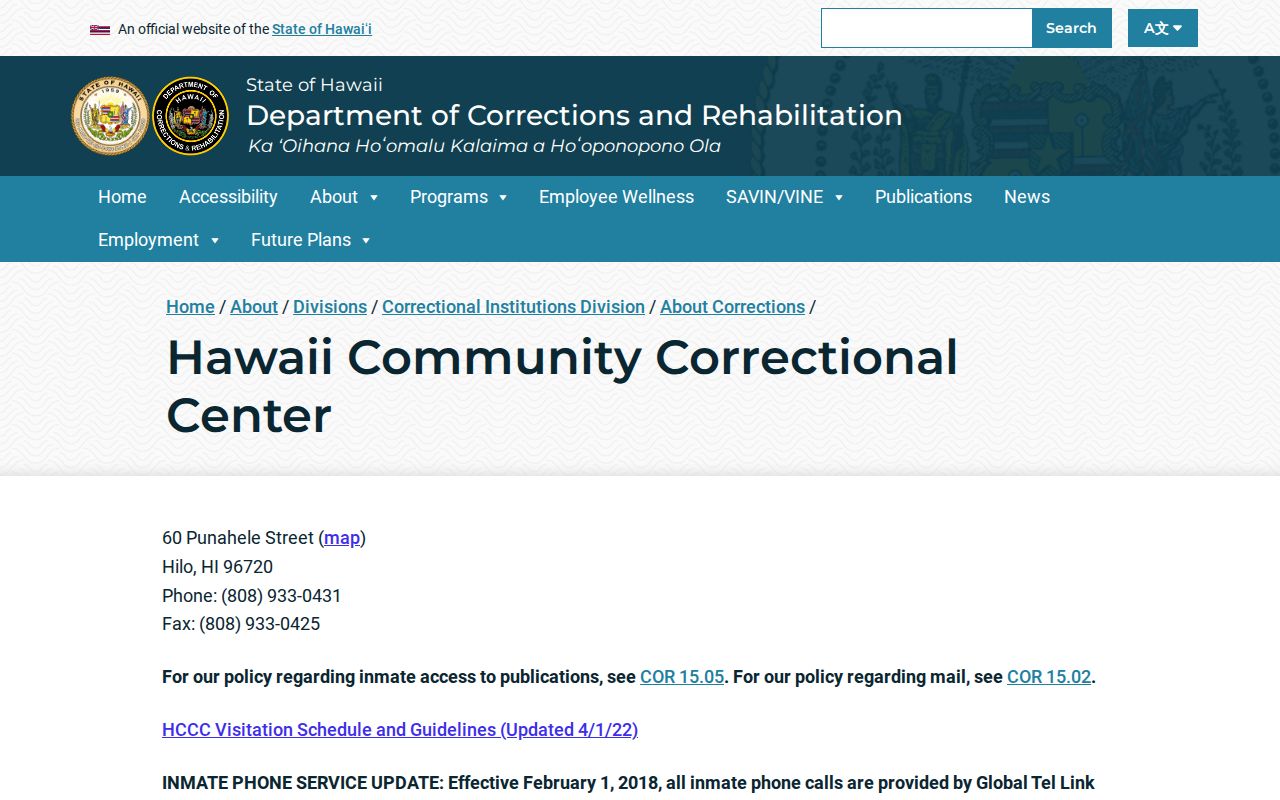
The source confirms HCCC's place in the state correctional system, which is essential when routing a release search away from a nonexistent county sheriff roster.
HCCC Court Release Versus Facility Release
The Third Circuit docket explains why a judge authorized release. HCCC records when DCR processed the event. Those can be different times. A court order can be entered before administrative steps finish, and another valid hold can change whether the person reaches the community.
DCR policy also distinguishes direct courtroom release. When acquittal, dismissal, or nolle prosequi ends all holds, the person may be released forthwith at court. DCR does not provide return transportation in that situation, and property may require later pickup. This should not be restated as an HCCC gate release.
For an older case, eCourt Kōkua may preserve bail, dismissal, judgment, sentence, probation, and other docket events after a transient custody screen no longer returns the person. A closed case is not itself a custody status. Use the court record for legal authority and the HCCC record for operational release.
The Kaumana HCCC Housing Unit
A 48-bed Kaumana housing unit was dedicated in December 2024 after years of planning, alongside intake and records renovations. DCR's dated announcement reported 304 people and about 135 percent occupancy at that time. These figures document a facility moment, not a current headcount and not an annual release total.
The distinction matters because population snapshots cannot be divided into a release rate or average stay. No defensible current annual HCCC release series was located. Use the announcement for local facility history only, and use an individual release record to answer whether one person left custody.
Note: Capacity and point-in-time population figures describe the facility, not the number or pace of Hawaii County releases.
HCCC Transfers to Federal or ICE Custody
No BOP prison or dedicated ICE detention facility was identified in Hawaii County. FDC Honolulu on Oʻahu is the relevant federal detention facility in the state. A person can therefore disappear from HCCC because of an off-island federal or immigration handoff rather than community release.
Use the BOP Inmate Locator for federal custody. A result stating “Released” or “Not in BOP Custody” ends only the BOP part of the trail and does not rule out another sovereign. ICE's locator addresses current ICE detention and certain CBP custody lasting more than 48 hours. A negative ICE result is not a release certificate; the Detention Reporting and Information Line, 1-888-351-4024, is the official escalation channel.
When the HCCC record says transfer or identifies a receiving agency, preserve that wording. Then search the receiving system. A criminal court dismissal can coexist with immigration custody, just as departure from HCCC can lead to federal detention.
HCCC in Hawaii's Unified Custody System
The defining Hawaii County feature is divided responsibility inside a unified state correctional structure. HPD runs the Hilo and Kona cellblocks and publishes the 48-hour booking log. DCR runs HCCC. The Judiciary controls the Third Circuit case, and HPA controls parole decisions and supervision. There is no county sheriff jail roster joining those records.
If HPD released a person before HCCC admission, no HCCC record may exist. If HPD transported the person to HCCC, continue with DCR and SAVIN. If HCCC transferred the person to Kulani or another state institution, the statewide record is the correct next path. Following the agency that actually held the person prevents a narrow roster search from becoming a false release claim.
Reconciling an HCCC Release Record
A complete answer may require three documents. SAVIN supplies the reported custody-change event, the Third Circuit case supplies the legal order or sentence, and the HCCC record supplies the time DCR ended or changed custody at the facility. These sources can carry different dates because each records a different act.
Start with identity. Compare the full name and variants, DCR or offender number, OTN, arrest date, report number, and case number where available. Hawaii names can contain an okina, spaces, hyphens, or multiple surnames, and exact-match systems may handle those forms differently. Do not publish a birth date, address, or other identifier merely because it appears during the search.
If sources conflict, prefer the individual order or facility record for the fact it directly controls, followed by current law and policy, and then a current official system result. Preserve each source's scope: “the court ordered release,” “DCR recorded transfer,” and “SAVIN currently reports” are clear statements. Combining them into an unsupported claim that the person returned to the community is not.
Public Record Search
Sponsored Results