
Releases From HPD Cellblocks
Hilo and Kona cellblocks hold arrested adults during the first stage of police processing. A person may post bail, be cited or otherwise released, appear in court, or be transported to Hawaiʻi Community Correctional Center. HCCC is operated by the Hawaiʻi Department of Corrections and Rehabilitation, not the police department and not a county sheriff. Once HPD confirms transport to HCCC, the custody search must move to DCR and Hawaiʻi SAVIN/VINE.
“Released from the cellblock” has a narrow scope. It can mean return to the community, but it can also reflect delivery to court or another agency. Read the Release Description and any receiving information with the Released On date. A court event supplies the legal authority. The HPD cellblock record supplies police processing. A later DCR record supplies the HCCC outcome.
| HPD outcome | What it means | Next record |
|---|---|---|
| Released after police processing | HPD custody ended | HPD report and court docket |
| Taken to court | Court controls the next legal step | Third Circuit docket/order |
| Transported to HCCC | State DCR custody begins | SAVIN, HCCC, DCR record |
| Transferred to another agency | Custody may continue | Receiving agency |
Check HPD Cellblock Releases
Hawaiʻi County publishes a rolling 48-hour Media Booking Log. No separate official 24-hour or 72-hour released-person feed was found. The PDF is an arrest-and-charge report, not a release-only roster. It carries useful release fields, but entries can repeat or change as the rolling window updates.
- Open the HPD booking-log archive and choose the current dated PDF.
- Read the report's printed time range. Do not assume the file covers a calendar day.
- Search the exact name and compare the arrest date, station, report number, OTN, and charges.
- Read Released On and Release Description together. Do not count a blank field as release.
- Call the correct cellblock for current status, then use SAVIN if HPD confirms transport to HCCC.
- Use the Third Circuit docket or a focused records request when the event needs formal proof.
The official HPD booking-log page appears below so the source and report archive can be recognized.
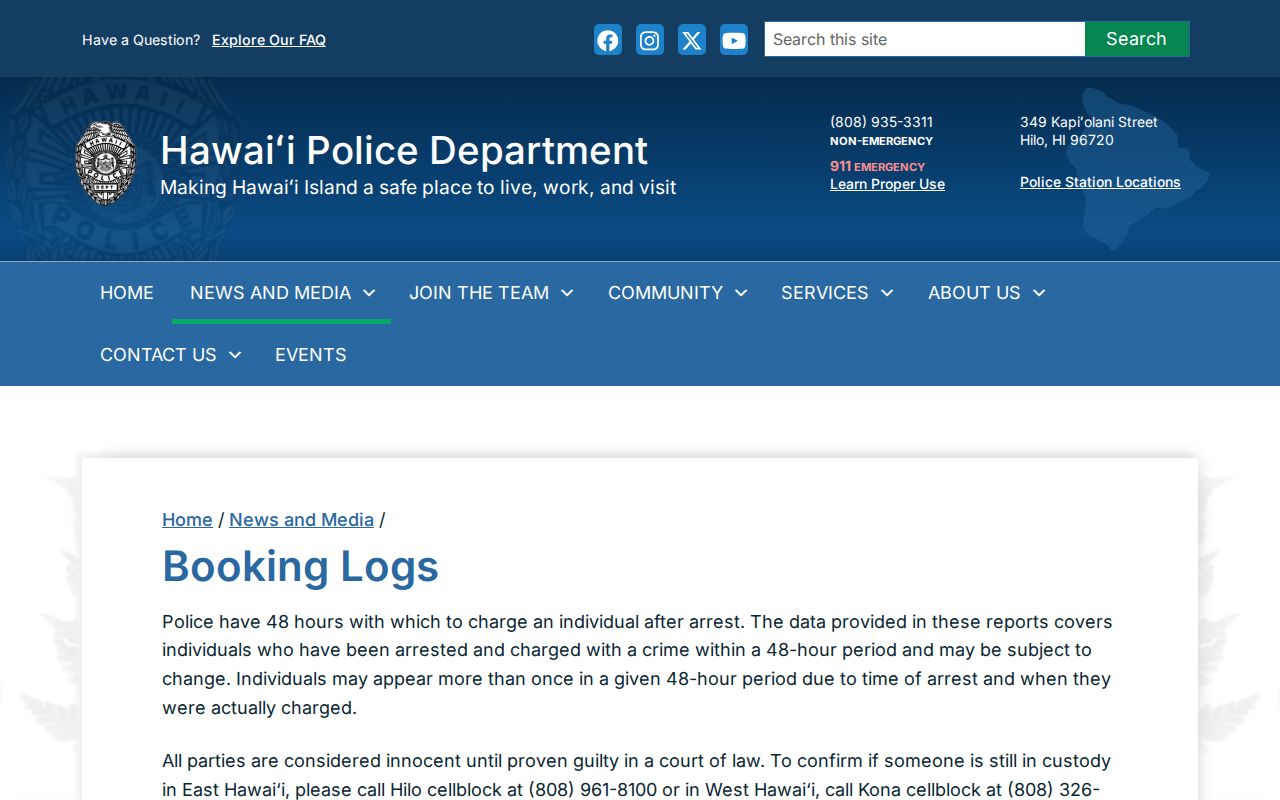
The screenshot shows the official access point. The live PDF and direct phone confirmation control the current inquiry.
HPD Cellblock Log Fields
The log contains more than a name. Useful identity and event fields include booking or arrest time, report number, offense tracking number, charge information, bail information, Released On, and Release Description. Field labels should be copied exactly from the current file. The report has no booking photographs.
A release date in the HPD report establishes the end of that police-processing episode. It does not establish the end of a later HCCC admission. A transfer description must be retained as a transfer. When two editions repeat the same person, reconcile the fields rather than counting two releases. An updated entry can add or correct facts.
- OTN
- An offense tracking number used to connect the arrest and related records.
- Released On
- The date and time HPD reports that its custody episode ended.
- Release Description
- The stated route or authority for the HPD outcome.
- Transfer
- Movement to another custodian, not community release.
The 24-Hour Releases and 72-Hour Releases pages explain how to work cautiously with the 48-hour source when those shorter or longer windows are needed.
HPD Hilo and Kona Contacts
Use the cellblock that handled the arrest. Hilo cellblock is (808) 961-8100. Kona cellblock is (808) 326-4646 extension 293. Ask a precise question: was the person released from police processing, taken to court, transported to HCCC, or transferred to another agency? That wording avoids treating any departure as community release.
Hilo, Hawaiʻi
(808) 961-8100
Current police-custody routing
Kona, Hawaiʻi
(808) 326-4646 ext. 293
Current police-custody routing
For report records, contact the HPD Records and Identification Section at 349 Kapiʻolani Street, Hilo, HI 96720, (808) 961-2233. East Hawaiʻi records uses that number. West Hawaiʻi records is (808) 326-4646 extension 285. The arrested-adult information number is (808) 961-2213.
Telephone contacts can change. Identify the office and task when calling. A records clerk can route a report request, while a cellblock answers immediate police-custody questions. Neither office should be asked to confirm a later DCR parole or prison discharge.
Request HPD Release Records
Hawaiʻi's Uniform Information Practices Act, HRS Chapter 92F, governs state and county agency records. A narrow HPD request should identify the adult, report number, OTN, arrest date, and the specific event fields sought. Ask for booking or admission time, Released On date and time, Release Description, bail set or posted, and the released-by or receiving agency field if maintained and disclosable.
The HPD report-request source says a response or report is provided within ten business days. It lists $1 for the first report page and ten cents for each added page, cash only, subject to the page's current terms. That is the police-report copy price. It is not a DCR fee, court price, or guaranteed photograph fee.
Ask HPD to segregate exempt material and release the non-exempt remainder. Juvenile, medical, victim, active-investigation, safety, and other protected information may be withheld. Request an electronic copy and a fee estimate. If the event led to HCCC, send a separate focused request to DCR for the state custody episode.
HPD Release and Court Records
The Third Circuit docket can preserve the legal outcome after a brief cellblock entry falls outside the rolling PDF. A dismissal, bail order, release condition, or time-served judgment may appear in eCourt Kōkua. “Case closed” alone does not establish custody status, and the online file is not always complete.
Hilo and Kona have separate legal-document contacts. Hale Kaulike Legal Documents is at 777 Kīlauea Avenue, (808) 961-7400. Keahuolū Courthouse Legal Documents is at 74-5451 Kamakaʻeha Avenue, (808) 322-8750. Request a named order or judgment by case number rather than every document.
The court action and HPD event should be stated separately. A judge may order release, while the police record shows when processing ended. If another valid hold exists, the receiving record may show continued custody. The broader Hawaiʻi County released-inmate search connects these sources.
From HPD to State Custody
Hawaiʻi's unified corrections structure is the defining local fact. HPD operates the initial police lockups and publishes the rolling report. DCR runs HCCC and the state prison system. The Judiciary controls bail, probation, and court orders. There is no Hawaiʻi County sheriff jail roster.
After HPD confirms an HCCC transfer, search the Hawaiʻi VINE person locator. A VINE transfer or location event can point to the current DCR site. Contact HCCC at (808) 933-0428 if the result is unclear. A name missing from VINE can reflect timing, spelling, or system coverage, so it is not proof of release.
If the person was cited and released without HCCC admission, no HCCC record may exist. Continue with the HPD report and court case. Following the actual custodian keeps each record within its proper scope.
Federal Transfers From HPD Custody
No BOP prison or dedicated ICE detention center was identified in Hawaiʻi County. A local arrest can still lead to a federal or immigration transfer. The relevant federal detention facility in the state is FDC Honolulu on Oʻahu. Leaving an HPD cellblock or HCCC under a federal hold is not community release.
Use the BOP Inmate Locator for federal criminal custody. Use the ICE Online Detainee Locator for current ICE custody and qualifying CBP custody. A negative result is not universal proof of release. Ask HPD which agency received the person, then follow that agency's locator and docket.
Keep the final statement precise: released from HPD, transferred to HCCC, taken to court, or delivered to a federal authority. Each describes a different result.
Preserve HPD Release Proof
The rolling log is useful at the time of an arrest, but HPD does not promise a permanent public archive. Save the PDF, its printed coverage range, and the access date when a matching release field appears. For lasting proof, request the underlying report and reconcile it with the court or DCR record.
A saved report should not be read beyond its scope. It shows the police custody episode reported in that edition. A later correction, court order, HCCC admission, or transfer record may add facts. Keep each event dated and tied to the office that created it.
That sequence preserves the difference between an HPD release and continued custody elsewhere.