
Hawaiʻi County Parole Versus Probation
Parole is conditional release from a state prison sentence. The Hawaiʻi Paroling Authority, or HPA, sets minimum terms and decides parole for eligible state prisoners. A person on parole has left the prison, but the sentence and HPA supervision continue. Probation is a sentence imposed by the Third Circuit court. It may follow a short jail term, replace incarceration, or start after a court disposition. Adult probation staff of the Hawaiʻi Judiciary supervise that court order.
The difference matters when checking a released person. HPA records and Hawaiʻi SAVIN are the useful first channels for parole. A Third Circuit docket and the Hilo or Kona Adult Probation office are the direct channels for probation. Hawaiʻi Community Correctional Center is often called the county jail, but it is operated by the Hawaiʻi Department of Corrections and Rehabilitation, not a county sheriff. Its custody record does not replace either agency's supervision record.
| Point | Parole | Probation |
|---|---|---|
| Who orders it | HPA authorizes release under a prison sentence | Third Circuit court imposes the sentence |
| Who supervises | HPA and its parole staff | Judiciary Adult Probation |
| Best public trail | SAVIN event, HPA order, DCR release record | eCourt docket, judgment, probation office |
| How it ends | Discharge or sentence expiration under HPA authority | Court-ordered completion, discharge, or other case action |
- Parole
- Conditional community release during a prison sentence.
- Probation
- Court-ordered supervision that may be imposed instead of, or after, custody.
- Discharge
- The formal end of custody or supervision under the controlling authority.
- Absconder
- A person alleged to have stopped reporting or left supervision without approval; the agency must confirm the status.
Check Hawaiʻi County Supervision
Verification starts with the sentence, not a guess based on where the person was last held. A release from HCCC may lead to probation, parole, a transfer, or no supervision at all. Kulani Correctional Facility releases may involve parole, furlough, another DCR placement, or maximum-term discharge. The direct Hawaiʻi VINE person search covers DCR jail and prison custody and supported parole events, but it does not replace an individual HPA order or probation record.
- Search the person's full name or offender ID in Hawaiʻi SAVIN/VINE. Match the record carefully and note whether the event says parole, discharge, release, or transfer.
- Search the eCourt Kōkua criminal docket gateway. Find the judgment, sentence, probation order, or later revocation and discharge entries.
- For parole, contact HPA with the person's name, DCR number, case number, and sentencing court. Ask for the individual order or current public status.
- For probation, call the correct Third Circuit Adult Probation office. Hilo and Kona have separate contacts.
- If the systems conflict, request the DCR release record and the named court document. State each verified fact separately rather than treating a missing result as proof.
The full custody trail and records-request fallback are covered on the Hawaiʻi County released-inmate search. No result means only that supervision was not confirmed through that channel. Spelling, timing, sealed records, system coverage, and an off-island placement can affect the result.
Hawaiʻi County Supervision Offices
HPA is based in Honolulu and handles state parole authority. Its official page provides publications and general contact information, but the reviewed source did not show a public individual hearing calendar or searchable decision database. A case-specific question belongs with HPA and the person's own order. General office hours are weekdays from 7:45 a.m. to 4:30 p.m., except holidays.
1177 Alakea Street, Ground Floor
Honolulu, HI 96813
(808) 587-1300
HPA official page
Probation is divided locally. Hale Kaulike in Hilo has Adult Probation at (808) 961-7600. Keahuolū Courthouse in Kona lists Adult Supervision at (808) 443-2191. The Third Circuit directory carries both offices and should be checked for current routing. Court counter hours are not jail release hours, and an office phone cannot confirm a DCR custody event.
Hale Kaulike, 777 Kīlauea Avenue
Hilo, HI 96720
(808) 961-7600
Keahuolū Courthouse, 74-5451 Kamakaʻeha Avenue
Kailua-Kona, HI 96740
(808) 443-2191
The official HPA source page is shown below so its agency identity and publications can be recognized before making contact.
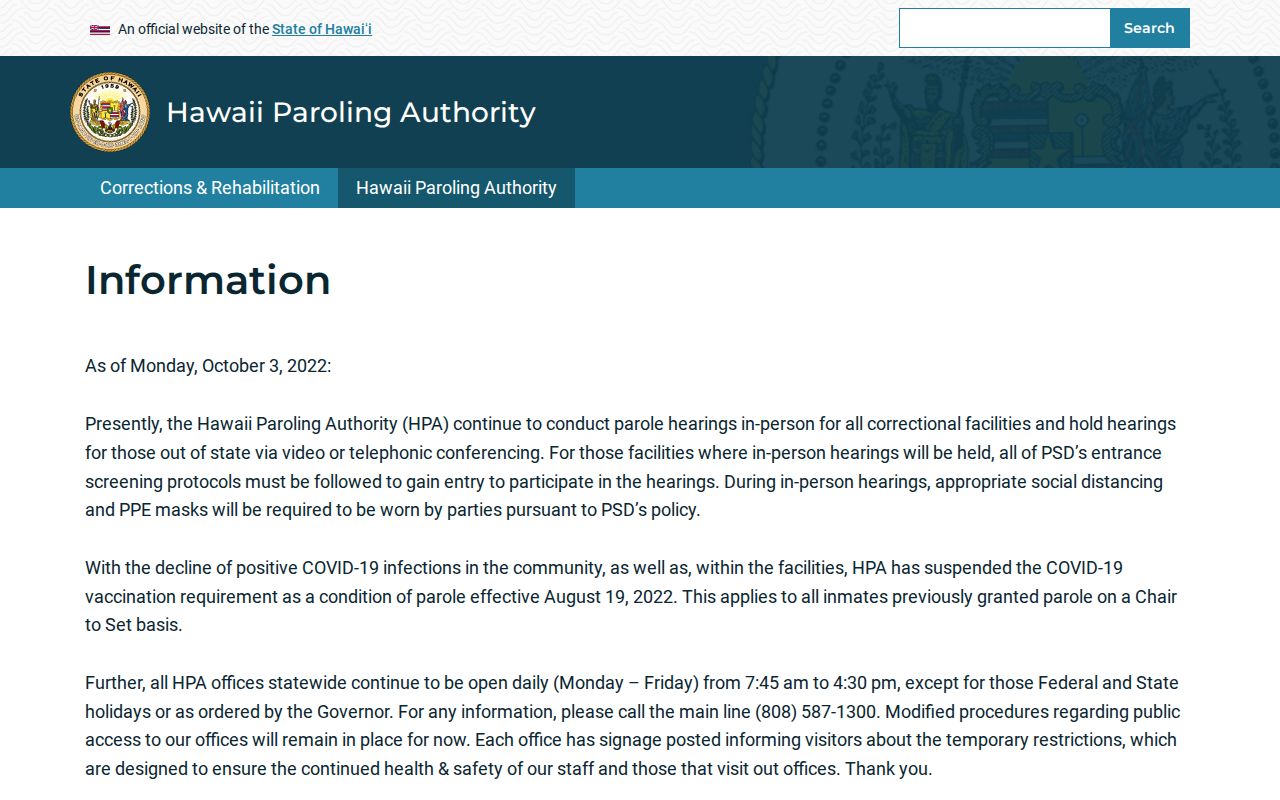
The image supports the HPA route, but an individual order and current agency confirmation control the person's case.
Hawaiʻi County Parole Decisions
HPA normally fixes a prisoner's minimum term within six months after commitment under HRS Chapter 706. The tentative parole date is the expiration of the longest minimum and a point for parole consideration. It is not a promise of departure. A favorable action can still depend on an approved parole plan, administrative processing, another warrant, or a hold.
The reviewed HPA materials use terms such as minimum-term action, administrative review, grant, denial, reconsideration, suspension, revocation, reparole, and discharge. “Chair to Set” does not mean that release occurred. When parole is denied, written reasons and later review rules apply. The strongest proof is the person's HPA order paired with an actual DCR or SAVIN event. A hearing date alone proves neither release nor the start of supervision.
Hawaiʻi SAVIN can issue supported early-hearing, upcoming-hearing, decision, delay, parole, and discharge notices. Registering is useful for timely notice, but DCR warns users not to rely on notification alone. The VINE Inmate Check explains search, registration, and confirmation.
Hawaiʻi County Violations and Warrants
Supervision conditions are the rules in the controlling parole or probation order. They can address reporting, travel, programs, or other conduct, but the person's complete conditions are not a general public-search field. Do not infer a violation from a missed call, a move, or a stale VINE record. Ask the responsible office whether a public status can be confirmed.
An alleged violation can lead to a warning, hearing, warrant, arrest, suspension, revocation, or another court or HPA action. Revocation means supervision has been withdrawn after the required process and may return the person to custody. An absconder label generally means the agency alleges that contact or compliance has been lost. It does not disclose the full facts and should not be treated as a conviction. A warrant must be verified with the issuing court or supervising agency.
The official covered-offender registry is a separate, narrow system under Hawaiʻi law. It is not a list of all parolees or probationers. A registry match does not establish current custody, and a missing registry result says nothing about supervision. Use the record created for the question being asked.
Hawaiʻi County Reentry Custody
Hawaiʻi Island has local custody-transition programs that can explain why a person is no longer in the same facility. DCR's community resource guide describes Hale Nani, part of HCCC, as a work-release and reintegration site for sentenced people expected to release on Hawaiʻi Island. The Kulani Correctional Facility page describes a minimum-security prison that prepares people for furlough and reentry.
Placement at Hale Nani, a furlough step, and parole are not interchangeable. Each has its own authority and degree of custody. A person can be in a transition program without having reached unconditional discharge. Use DCR for facility status, HPA for parole authority, and the court for probation. These local routes help reconcile a location change, but none guarantees a particular outcome for one person.
Reentry also may happen off island. DCR's statewide system can place a Hawaiʻi County case in another Hawaiʻi institution or an approved out-of-state facility. Search statewide and keep the DCR identifier with the record. Restricting the query to the Big Island can miss the controlling custody path.
Property After Hawaiʻi County Release
DCR property policy creates a practical link between release and identity. Under COR.17.02, identification documents are separated for retention until release. The policy also protects some useful belongings of a person who is homeless from the ordinary excess-property disposal schedule. Those safeguards can matter when identification is needed for supervision intake or other post-release tasks.
Property pickup is a separate transaction from custody verification. An authorized recipient must meet the policy's identification and signature rules. A court release can also mean the person does not return to the facility, so property may need to be collected later. Call the holding facility before travel and ask about its current process. Do not infer that a person remains confined merely because belongings have not been retrieved.
A DCR property acknowledgment can help document processing, but it is not the same as a discharge order. For an official custody record, request the actual release or transfer date, legal authority, and receiving category under HRS Chapter 92F.
End of Hawaiʻi County Supervision
Parole ends through a formal HPA discharge or the controlling sentence authority. Probation ends through the court record, not merely because scheduled reporting stopped. Maximum-term discharge is different from parole discharge, and a completed term is different from a transfer or revocation. Ask for the exact action and date.
A useful final record set includes the HPA discharge or court order, the DCR release event when custody was involved, and the docket entry that reflects the legal result. Older events may no longer appear in VINE. A narrow records request can seek the non-exempt release-status fields and the individual order. Hawaiʻi's UIPA permits any person to request agency records, subject to exemptions and redaction.
When records disagree, do not choose the most favorable date. Report the court action, HPA action, and actual custody event separately. The end of supervision is confirmed only by the authority that imposed or administered it.