
Hawaii County 24-Hour Release List Status
Hawaii County does not operate a sheriff-run jail roster or a distinct official view for people released today. Corrections are centralized under the Hawaii Department of Corrections and Rehabilitation, while HPD runs short-term Hilo and Kona cellblocks. The closest local source is HPD's 48-Hour Media Booking Log archive. It is an arrest-and-charge report with useful release columns, not a release-only roll and not an HCCC prison-discharge history.
HPD describes the product as a 48-hour report. A reviewed file had endpoints a little beyond an exact two-day span because of its production time. That does not create a guaranteed rolling-minute window. For a same-day review, use the Released On time to identify entries within the desired period, and keep the PDF's own printed range with any notes you save.
How to Check Hawaii County 24-Hour Releases
A sound check follows the custody trail instead of treating the booking PDF as a live jail screen. Begin with enough identity facts to avoid matching the wrong person, especially when a name includes an okina, hyphen, space, or more than one surname.
- Open the official HPD booking-log archive and select the newest PDF whose printed range covers the period being checked.
- Find the name and compare the arrest date, report number, OTN, charge, and court details where available.
- Read Released On and Release Description together. Do not turn a blank value into a claim of continued custody.
- For immediate police-cellblock status, call Hilo at (808) 961-8100 or Kona at (808) 326-4646, extension 293.
- If the person moved to HCCC, use Hawaii SAVIN/VINE and DCR. If the entry says court, inspect the Third Circuit docket for the later order.
For a search centered on one named person rather than everyone in a recent time window, the Hawaii County released-inmate search path reconciles cellblock, HCCC, court, state-prison, federal, and immigration sources.
Note: “Not confirmed through this channel” is accurate when a search fails; a missing result is not proof of release.
Fields in Hawaii County Recent Release Records
The HPD PDF contains more detail than a simple name list. The most useful columns link the arrest episode to the stated departure from police processing. Preserve the report number and OTN because they can help HPD, DCR, or the court distinguish people with similar names.
| Field | What it shows |
|---|---|
| Arrested On / Released On | The recorded police-processing times. Released On applies to the HPD episode, not necessarily all government custody. |
| Name and identity details | Name plus displayed sex, age, race, and city or address fields used to reconcile the correct entry. |
| Report number and OTN | Identifiers that connect the booking entry with a police record and later custody or court inquiry. |
| Charge and statute | The allegation, its statute, and whether the line reflects an arrest or charge event. |
| Bail set / posted | Amounts recorded in the log. These fields do not replace the judge's controlling order. |
| Release Description | Labels such as bail or bond, supervised release without bail, court, or Intake Service Center. |
| Released by / court data | The recorded releasing path, court code, and court date, which may lead to the next official check. |
“Released to District Court,” “released to Family Court,” and “Intake Service Center” must retain their stated scope. Each means the police cellblock episode changed. None alone proves the person then entered the community. Likewise, the PDF carries no booking photograph.
Reading the Hawaii County 48-Hour Source
The official HPD archive page shows the dated booking PDFs that serve as the closest public substitute for a same-day release list.
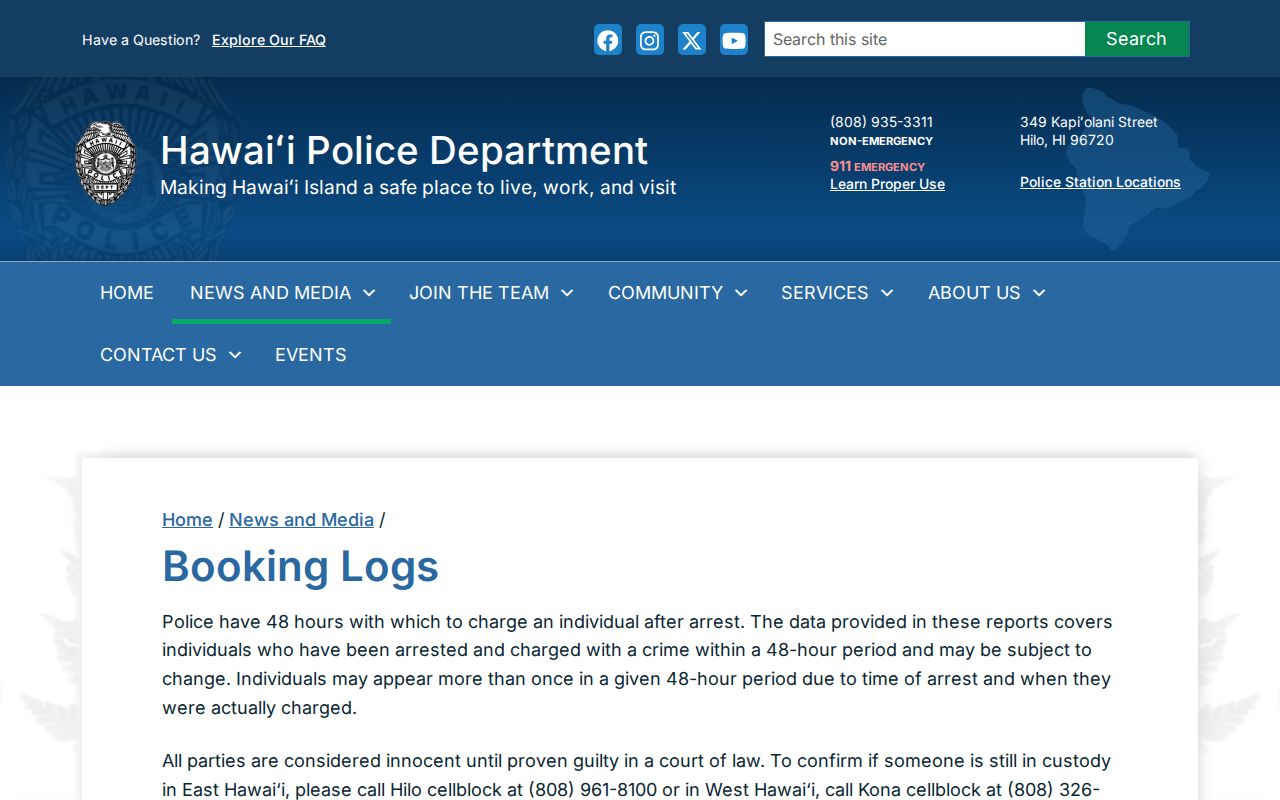
The archive context matters because an individual PDF is a snapshot. HPD warns that reports can change and repeat entries, and it publishes no permanent-retention promise.
Hawaii County Courtroom Release Logistics
A courtroom release can differ sharply from a departure at an HCCC gate. Under DCR release policy COR.16.02, a person is released forthwith at court when an acquittal, dismissal, or nolle prosequi ends all holds. DCR does not provide return transportation in that situation. Property may remain at the facility and require later retrieval through facility procedures.
The legal order and physical processing answer different questions. The Third Circuit docket establishes why release was authorized. DCR or HPD records show when custody at that location ended and whether another agency received the person. If those sources show different dates, report each fact with its source instead of choosing one as a universal release time.
Getting Home After a Hawaii County Release
Island geography shapes some DCR discharge plans. DCR policy COR.16.07 generally returns a person discharged at the maximum term to the island of conviction or sentence. Parole destinations follow the policy's parole rules and exceptions. Eligible in-state air travel is paid under the policy.
This rule does not promise a particular gate, hour, waiting area, bus stop, or route. No official source established those HCCC details. A family member should ask the facility for current logistics and use current transit information without assuming that the booking log's timestamp predicts the place where a person will arrive.
Note: A policy-based destination explains planning, but only the individual release or transfer record confirms what occurred in one case.
Hawaii County Bail Hours and Release Timing
The Third Circuit directory says court bail is accepted and processed Monday through Friday from 7:45 a.m. to 4 p.m. Those are court-counter hours. They are not HCCC gate hours, and they do not prove that police or DCR cannot process a release at another time.
No defensible local fixed bond schedule was found. The docket and the judge's order control the case. Around a weekend, separate the court transaction from police or DCR steps and from any other hold. This is why a person may have a court event in one system while the release or transfer field appears later in another.
Hawaii County Release Verification Fallbacks
When the newest PDF does not settle the question, match the next source to the agency that held the person. Hawaii SAVIN/VINELink covers people in Hawaii jails and prisons after DCR intake, but not someone still in an HPD cellblock and not a federal prisoner. A Third Circuit case can preserve the legal outcome after the short custody entry fades. For an older operational record, send a narrow UIPA request to HPD or DCR.
A release to the community ends custody at that point. A transfer ends one facility's custody while another agency or facility may continue it.
Ask HPD for the non-exempt cellblock record with Released On, Release Description, bail, and receiving-agency fields. Ask DCR for the actual release or transfer time, legal authority, and receiving category for an HCCC episode. Request electronic segregable portions and a fee estimate. For a wider review built from several dated reports, use the Hawaii County 72-Hour Releases guide.
Resolving Hawaii County Release Record Conflicts
Official sources can describe different stages without truly disagreeing. An HPD entry may record release to court in the morning. The Third Circuit may then enter an order in the case. DCR may later record admission, release, or transfer under its own process. Keep the subject beside each time: release from an HPD cellblock, release from HCCC, release on parole from state prison, or release from federal custody.
When facts conflict, give the greatest weight to the individual court order or facility record, then current law and agency policy, and then the live official status result. A current explanatory page or dated brochure supplies context but does not replace the person's actual record. If two entries use different spellings, compare the report number, OTN, offender number, arrest date, and case number before concluding that they refer to one person.
A transfer label should remain a transfer label even if the person disappears from the first source. For instance, a move from an HPD cellblock to HCCC ends police custody but begins DCR custody. A move from HCCC to federal or immigration custody has the same basic issue. The first agency's departure time cannot establish community release.
Public Record Search
Sponsored Results