
Hawaii County Release Records
“Released” describes the end of custody at a named agency. It does not always mean that the person returned to the community. Hawaiʻi Police Department may release an arrestee from a Hilo or Kona cellblock, send that person to court, or transfer the person to Hawaiʻi Community Correctional Center. HCCC is a state-operated jail under the Hawaiʻi Department of Corrections and Rehabilitation, not a county sheriff jail. A person leaving HCCC may go home, begin supervision, move to another DCR facility, or enter federal or immigration custody.
The strongest Hawaii County release record identifies the person, the holding agency, the actual date and time custody ended there, and the release description or receiving authority. SAVIN supplies timely DCR custody events. A Third Circuit docket supplies the legal order or sentence. HPD or DCR supplies the operational release or transfer entry. Those records answer different questions, so a reliable finding keeps them separate.
- Discharge
- The end of the stated custodial or supervision term.
- Time served
- A sentence satisfied by time already spent in custody.
- Parole
- Release from prison under Hawaiʻi Paroling Authority supervision.
- Probation
- Court-ordered community supervision administered by the Judiciary.
- Detainer
- A request or authority that can move a person to another agency instead of the community.
Hawaii County Release Routes
A release description controls the next search. Bond, release on recognizance, dismissal, acquittal, time served, and maximum-term discharge can end the named custody episode. Parole and probation place a person in the community under rules. Furlough or work release may be a community placement without final discharge. A transfer merely changes custodians. “Released to court,” “Intake Service Center,” a federal hold, or an ICE hold must never be shortened to “released.”
| Release route | Meaning | Next official check |
|---|---|---|
| Bond or court release | Police or DCR custody ends subject to the case and any other hold. | HPD record, SAVIN, and Third Circuit docket |
| Time served or discharge | The stated jail or prison term ends. | Facility record and court judgment |
| Parole or probation | Community supervision follows release or sentencing. | HPA/SAVIN for parole; Judiciary for probation |
| Transfer | One agency releases the person to another custodian. | Receiving DCR, BOP, or ICE system |
A person can have more than one open matter. A dismissal in one case does not clear another warrant or hold. Likewise, a blank “Released On” field in a changing HPD report does not prove continued custody. State the exact event the official record supports.
Hawaii County Release Fields
HPD’s booking log is unusually detailed for a recent public source. It can show the arrest time, a Released On time, release description, bail data, the releasing or receiving entity, report number, OTN, charges, court code, and court date. HCCC and DCR records should be requested for the later state-custody episode. A court docket may preserve the disposition long after a short cellblock entry is hard to find.
| Field | What it establishes |
|---|---|
| Name and agency ID | Helps match the correct custody episode without publishing extra personal data. |
| Admission or arrest date | Links the release to the correct booking or case. |
| Actual release date and time | Shows when custody ended at that facility. |
| Release description | States bond, court, time served, discharge, parole, transfer, or another route. |
| Released by or receiving agency | Shows whether another custodian took control. |
| Case, report, OTN, or offender ID | Connects facility, police, court, and SAVIN records. |
There is no official promise that an old HCCC release remains searchable in VINE. VINE is a custody and notification service, not a permanent archive. Save a contemporaneous official result when needed, then request the underlying record for durable proof.
Request Hawaii County Release Records
Hawaiʻi’s Uniform Information Practices Act, or UIPA, permits a focused request to the agency that created the record. HPD Records and Identification handles police cellblock material. DCR handles HCCC or Kulani custody records. The Third Circuit clerk handles court orders, judgments, and docket documents. Asking the wrong agency for every record can delay the answer.
- Identify the custodian: HPD, HCCC/DCR, Kulani/DCR, or the Judiciary.
- Give the full name and the known arrest, admission, case, report, OTN, or offender number.
- Ask for the non-exempt admission and release entry, actual date/time, release authority, and receiving agency.
- Request an electronic copy, segregation of protected fields, and a fee estimate before a stated cap.
- Compare the response with the related court or SAVIN event.
349 Kapiʻolani Street
Hilo, HI 96720
(808) 961-2233
HPD says a police report request receives a response or report within ten business days. Its published report price is $1 for the first page and ten cents for each added page, cash only. That price does not establish the cost of a photograph, DCR record, or court document. The Office of Information Practices request guidance explains the state process and fee rules.
Hawaii Release Law Limits
HRS Chapter 92F governs state and county agency records. Sections 92F-11 and 92F-12 set access duties, while section 92F-13 lists exceptions. Agencies should segregate accessible parts from protected material. Juvenile, sealed, medical, victim, security-sensitive, and active investigative information can be withheld or redacted.
Expungement is different from correcting an error. The Hawaiʻi Criminal Justice Data Center processes qualifying non-conviction arrest expungements under HRS §831-3.2. An expunged arrest photograph is confidential. For an unresolved arrest without a recorded disposition, access to a photo can also turn on the specific facts and OIP opinions. A court seal or agency expungement does not authorize a public website to recreate removed material.
Hawaii Courtroom Release Logistics
DCR policy creates a key Hawaiʻi distinction. When acquittal, dismissal, or nolle prosequi ends all holds, release occurs promptly at court. DCR does not return the person to the facility or provide transport elsewhere. Property left at the facility may need to be collected later. That means a family member waiting at HCCC could miss a release that happened at Hale Kaulike or Keahuolū Courthouse.
The Third Circuit accepts and processes bail during its stated weekday counter hours, but court hours do not define HPD or DCR release processing. No official weekend or holiday gate schedule was found. Confirm the court order and then ask the actual custodian whether processing or another hold remains. DCR release procedure COR.16.02 is the source for the courtroom rule.
Returning After Hawaii Release
Island geography affects a state discharge. Under DCR’s island-return policy, a person reaching a maximum-term discharge is generally returned to the island of conviction or sentence. Parole follows separate destination rules, subject to approved exceptions. Eligible in-state air travel is paid under the policy. These rules do not promise a particular flight, pickup place, or time.
No official source established HCCC gate-release hours, a family waiting area, a bus stop at the gate, or “gate money.” Ask HCCC for current logistics. Current Hele-On routes can help with general travel planning, but they should not be presented as a guaranteed release shuttle.
Find Hawaii County Released Inmates
Start with the last known custodian. Hawaii County has no sheriff-run jail roster. HPD handles short-term cellblocks and publishes the booking log, while DCR runs HCCC and Kulani. The Judiciary controls court dispositions and probation. HPA controls parole decisions and supervision. Federal and immigration custody require federal systems.
- For a recent HPD arrest, inspect the official 48-hour log and its Released On and Release Description fields.
- After HCCC or state-prison intake, search Hawaiʻi SAVIN/VINE by exact name and offender ID when known.
- Read the Third Circuit docket for the order, judgment, dismissal, sentence, or probation term.
- For parole, verify the individual HPA order and an actual SAVIN/DCR event.
- For federal or immigration custody, use BOP or ICE and check for a transfer.
- If the online trail is incomplete, request the release/transfer record from its creator.
The 24-Hour Releases page explains how to filter the official 48-hour source without calling it a county-published 24-hour feed. The Release Date Lookup separates a tentative date from an actual departure.
Hawaii SAVIN Release Search
DCR does not offer a conventional permanent offender-profile database. It directs public location questions to Hawaiʻi SAVIN/VINE person search. Select Hawaiʻi, enter the exact first and last name, and add an offender number if known. Compare the identity before opening a record. Read the stated custody or parole status and latest event. Transfer, release, discharge, and parole are not interchangeable.
| Search item | Use | Caution |
|---|---|---|
| First and last name | Primary person search | Try ʻokina, hyphen, spacing, and multiple-surname variants. |
| Offender ID | Narrows a common-name match | Use only the ID tied to Hawaiʻi custody. |
| Custody/parole status | Shows the system’s current reported state | Confirm an actual release through DCR or court records. |
| Latest event | Distinguishes release, transfer, or parole activity | No match is inconclusive. |
The official Hawaiʻi SAVIN page shows the service scope and registration choices.
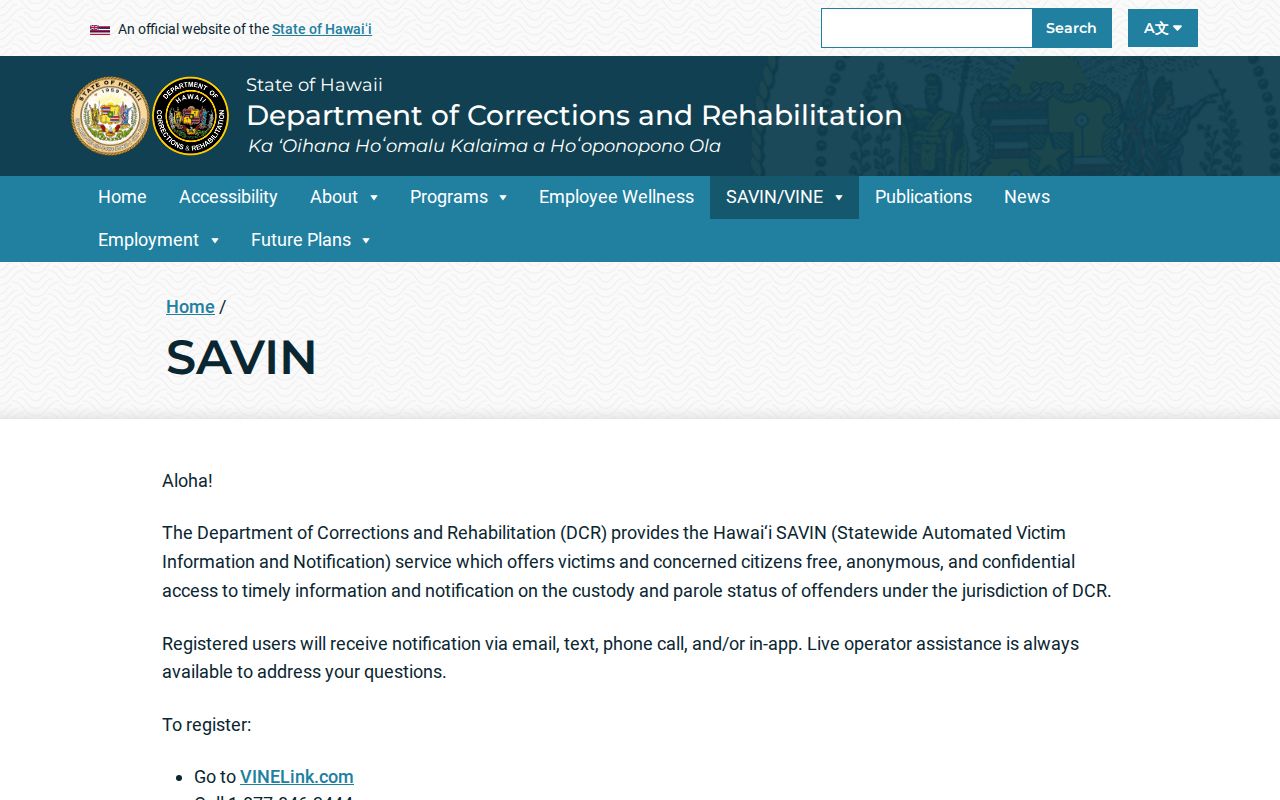
SAVIN covers DCR jail and prison custody and parole events. It does not cover a person still in an HPD cellblock or a federal prisoner.
Hawaii County Recent Releases
HPD publishes a rolling 48-Hour Media Booking Log, not separate official 24-hour and 72-hour released-inmate lists. The PDF reports arrests and charges and includes Released On, release description, bail, released-by, court, report, and OTN fields. Entries may change or repeat as arrest and charge data develops. It contains no booking photos.
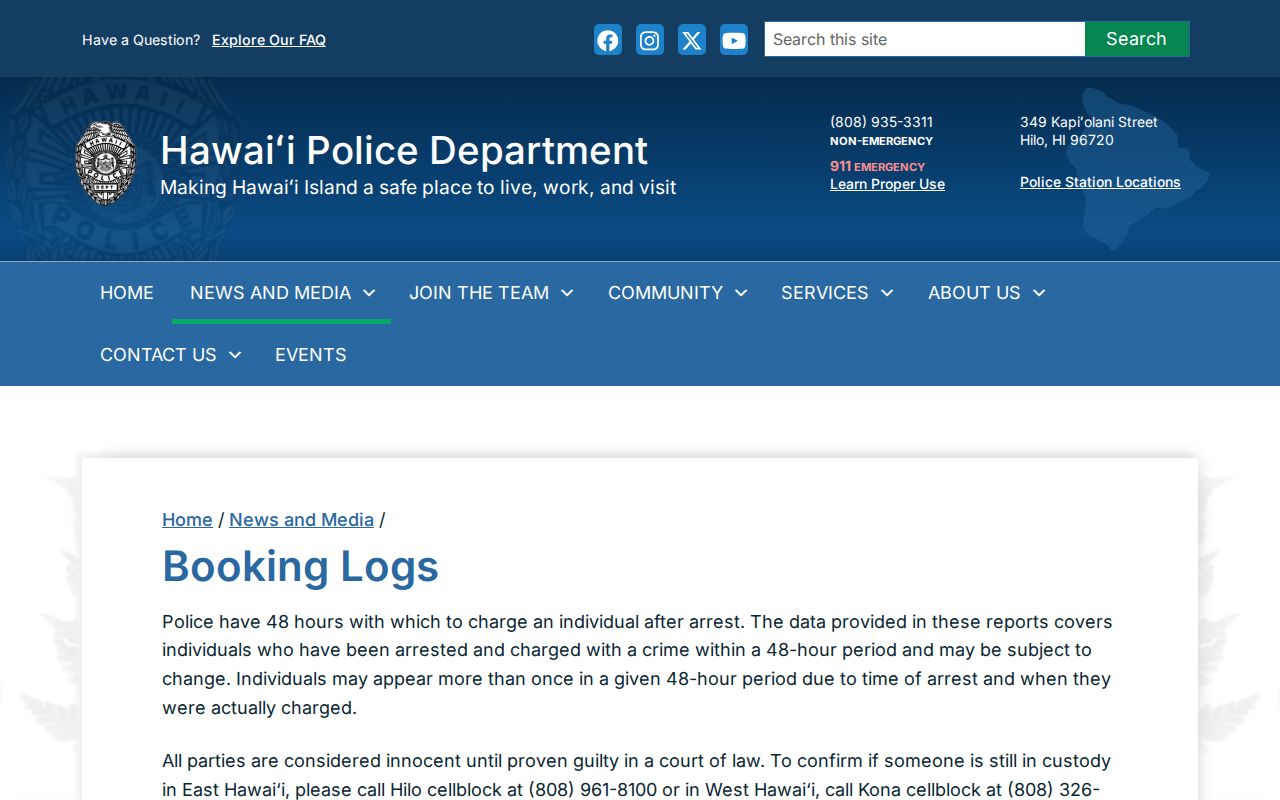
Filter Released On cautiously for a recent window. A release to court or the Intake Service Center is not proof of community release. Call the Hilo cellblock at (808) 961-8100 or Kona at (808) 326-4646 extension 293 for immediate police custody; use SAVIN after transfer to HCCC.
Hawaii Post-Release Supervision
Parole and probation belong to different agencies. The Hawaiʻi Paroling Authority supervises parolees and holds the individual parole order. Third Circuit Adult Probation is a Judiciary service. Hilo Adult Probation can be reached at (808) 961-7600, while Kona Adult Supervision uses (808) 443-2191. Privacy rules may limit person-specific details, so the sentencing docket is the public fallback for probation orders.
Hale Nani at HCCC provides reintegration and work-release functions for sentenced people expected to release on Hawaiʻi Island. Kulani prepares minimum-security prisoners for furlough and reentry. These programs describe a custody transition, not a promised outcome. DCR also retains identification documents until release and gives special protection to certain useful property of a homeless detainee. See Post-Release Supervision for HPA and Judiciary verification paths.
Hawaii Release Court Records
Hawaiʻi Island’s Third Circuit has separate Hilo and Kona locations. eCourt Kōkua can preserve a disposition after an HPD cellblock entry or transient VINE result is gone. Search the correct case and inspect bail orders, dismissals, judgments, sentences, probation, revocation, and discharge entries. “Case closed” alone does not establish release, and an open appeal does not establish continued custody.
The Judiciary warns that online data may not be the complete official file. A missing PDF icon means a document is not online, not that it does not exist. Older or non-digitized records can be requested from Hale Kaulike in Hilo or Keahuolū Courthouse in Kona.
The Judiciary’s eCourt availability page identifies coverage and access limits.
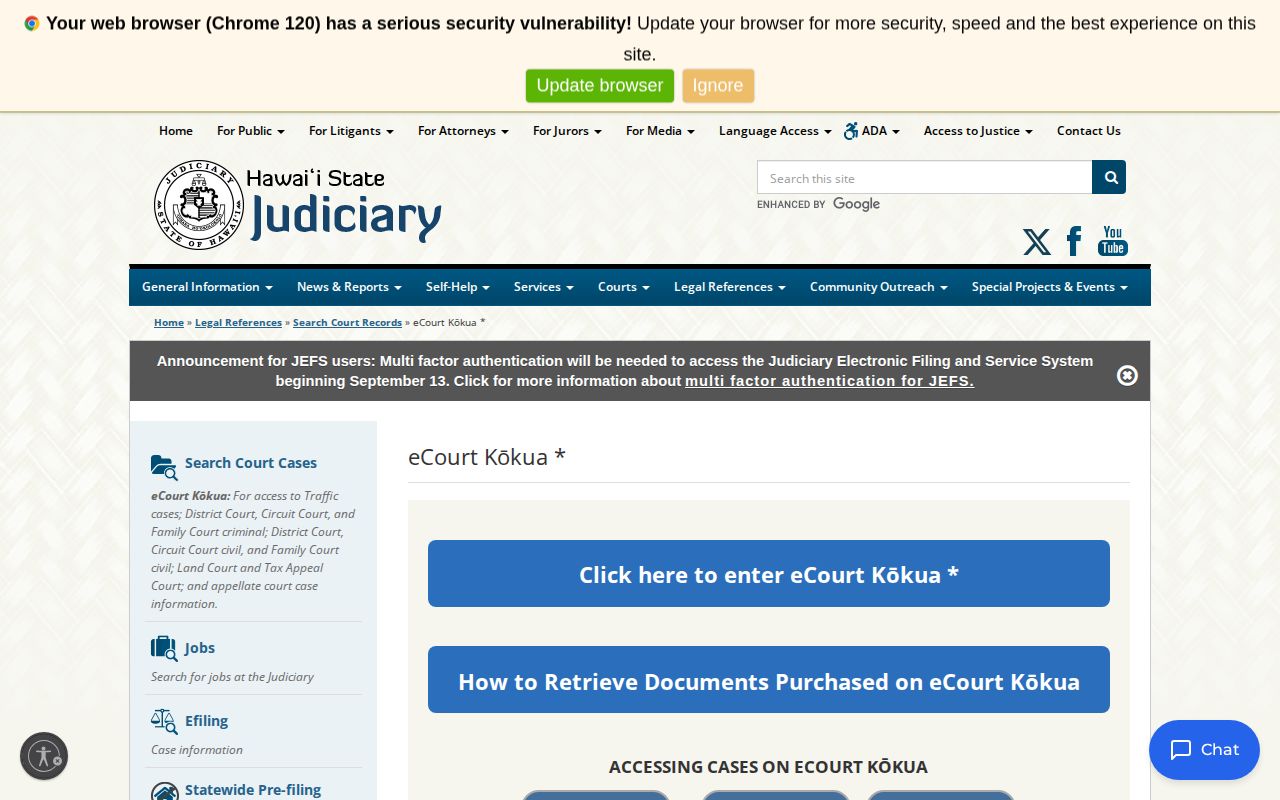
A court order explains the legal basis; the facility record establishes actual processing and any receiving agency.
Hawaii Release Alerts and Transfers
SAVIN notifications are available by web, telephone, text, email, and supported app channels. Registration is confidential from the offender. The official brochure requires a four-digit PIN for telephone or text registration; a recorded call repeats until the PIN acknowledges it. DCR warns against relying on SAVIN alone, so confirm a notice with the facility or court record.
No BOP prison or dedicated ICE detention facility was identified inside Hawaii County. FDC Honolulu on Oʻahu is the relevant federal facility in the state. A person who leaves HCCC may therefore have been transferred off-island rather than released to the community. Use the Federal Bureau of Prisons locator path for federal custody and the ICE detainee locator path for immigration custody. A BOP “Released” date ends federal custody only; another sovereign may take custody next.
Hawaii Custody Status Sources
Choose the system by custody type. A negative result means only “not confirmed through this channel.” It should trigger the next official source, not a conclusion.
| Source | Best use | What it cannot prove alone |
|---|---|---|
| HPD 48-hour log | Recent police booking and Released On fields | Later HCCC or court outcome |
| Hawaiʻi SAVIN/VINE | DCR custody and parole events | Permanent history or HPD/federal custody |
| Third Circuit docket | Legal order, disposition, and sentence | Exact facility processing time |
| HPA or Adult Probation | Post-release supervision authority | Unconditional discharge unless stated |
| BOP or ICE | Federal or immigration custody | State or local custody status |
Hawaii County Release Facilities
The custody map includes actual local facilities and locator-only paths when no county facility exists. HCCC is the primary state-run jail. Kulani is the island’s minimum-security state prison. HPD’s Hilo and Kona cellblocks cover short-term police custody. BOP and ICE pages explain off-island federal searches.
- Hawaiʻi Community Correctional Center
- Kulani Correctional Facility
- Hawaiʻi Police Department Hilo and Kona cellblocks
- Federal Bureau of Prisons system
- ICE custody
HCCC’s Kaumana housing unit was dedicated in December 2024 alongside intake and records improvements. DCR’s reported occupancy at that dated event is facility history, not a current release statistic. No defensible annual county release total or average HCCC stay was found, so neither should be inferred from headcounts.